
Employers liability coverage is insurance that protects your business against employee lawsuits arising from workplace injuries or illnesses that workers’ compensation does not cover. This is a distinct policy from workers’ comp, and confusing the two leaves serious legal gaps. Business owners and HR managers who understand employers liability insurance details can avoid costly surprises when an employee files a negligence claim. This article breaks down what the policy covers, how it differs from workers’ compensation, what compliance requires, and how to manage your coverage effectively.
What does employers liability coverage protect against?
Employers liability coverage protects against four main categories of employee lawsuits. Understanding each one helps you see exactly where your exposure lies.
Coverage includes negligence, dual capacity, and loss of consortium claims that workers’ compensation simply does not address. That means a single gap in your policy structure can expose your business to significant legal costs.
- Negligence claims. An employee argues you failed to provide a safe work environment. For example, a warehouse worker slips on a wet floor that management knew about but did not fix.
- Dual capacity claims. Your employee is injured by a product your company manufactured. The employee sues you both as their employer and as the product manufacturer.
- Loss of consortium claims. The injured employee’s spouse or family member sues for the loss of companionship or support caused by the workplace injury.
- Third-party over claims. A third party, such as a contractor, gets injured on your site. They sue the employee who caused the incident. That employee then brings your company into the lawsuit.
Beyond the claim types, the policy also covers your legal defense costs including attorney fees, court expenses, and settlements. That coverage applies even if the claim is ultimately dismissed.
What the policy typically excludes: intentional acts by the employer, claims arising from contractual liability, punitive damages in some jurisdictions, and injuries to employees who are not covered under the policy terms.

Pro Tip: Review your exclusions list carefully before a claim happens. Many business owners discover gaps only after a lawsuit is filed, which is the worst possible time.
How does employers liability coverage differ from workers’ compensation?
Workers’ compensation and employers liability coverage work together, but they cover completely different risks. Mixing them up is one of the most common mistakes business owners make.
Workers’ compensation is a no-fault system. It pays an injured employee’s medical bills and lost wages regardless of who caused the accident. The employee gives up the right to sue in exchange for guaranteed benefits. Workers’ comp pays medical costs and wages; employers liability covers lawsuits and legal defense. That distinction matters because some injuries lead to lawsuits even after workers’ comp pays out.
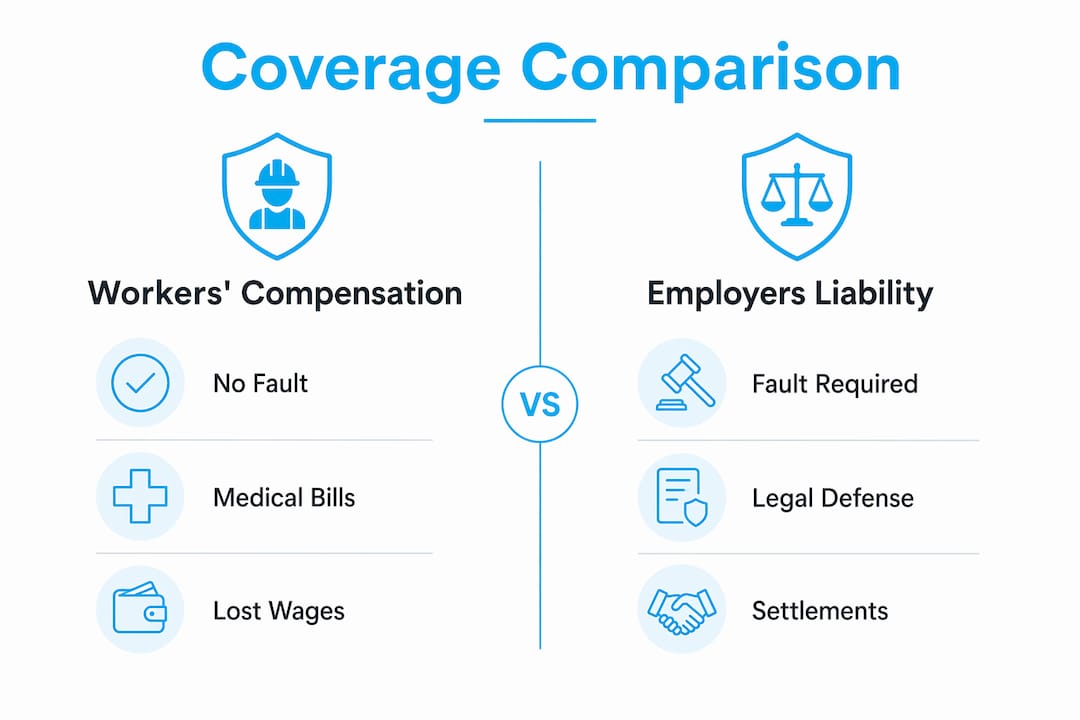
Employers liability coverage kicks in when an employee steps outside the workers’ comp system and sues you directly. That happens more often than most business owners expect, especially in negligence or dual capacity scenarios.
| Feature | Workers’ compensation | Employers liability coverage |
|---|---|---|
| Fault required | No | Yes |
| Covers medical bills | Yes | No |
| Covers lost wages | Yes | No |
| Covers lawsuits | No | Yes |
| Covers legal defense | No | Yes |
| Covers loss of consortium | No | Yes |
One important nuance involves monopolistic states. Ohio, Washington, North Dakota, and Wyoming require separate stop-gap coverage because their state-run workers’ comp funds do not include employers liability protection. If you operate in those states, you need a standalone stop-gap policy. Skipping it leaves you fully exposed to employee lawsuits in those jurisdictions.
For a deeper look at how workers’ compensation interacts with your broader coverage, the workers’ compensation insurance guide at Mfandtna explains the legal gaps that employers liability coverage fills.
Legal and regulatory compliance for employers liability coverage
Compliance with employers liability requirements is not optional. Failing to carry the right coverage exposes you to fines and leaves your business legally unprotected.
Here are the core compliance requirements every business owner should know:
- Carry the legal minimum coverage. The legal minimum indemnity limit is £5 million per occurrence in the UK, though £10 million is the standard most insurers recommend. In the US, limits vary by state and policy structure, so confirm your limits with a licensed broker.
- Display your certificate. Insurance certificates must be displayed visibly or electronically for employees. A digital display on your company intranet or HR portal satisfies this requirement in most jurisdictions.
- Retain records for the long term. You must keep copies of your insurance certificates for at least 40 years. Occupational diseases like mesothelioma can take decades to appear, and a former employee may file a claim long after their last day of work.
- Know who must be covered. Most employees working under a contract of service or apprenticeship require coverage. Labor-only subcontractors often qualify as employees under the law, even if you classify them differently.
- Avoid noncompliance penalties. Daily fines reach up to £2,500 for failing to carry compliant coverage. Those fines accumulate quickly and add up to a serious financial hit for any small business.
Pro Tip: Misclassifying workers as independent contractors when they function as labor-only subcontractors can void your coverage entirely. Audit your worker classifications annually to stay compliant.
Legal defense costs can erode the standard minimum limit faster than most business owners realize. A complex negligence case can consume a large portion of a £5 million limit before any settlement is paid. That is why the £10 million limit is the practical standard for most businesses.
How much does employers liability coverage cost?
Employers liability coverage costs vary widely based on your industry, workforce size, and claims history. The good news is that premiums for low-risk businesses are very manageable.
Annual premiums for small, low-risk businesses start from £50 to £100 per year. That starting point makes coverage accessible even for sole traders with one or two employees. Higher-risk industries pay significantly more.
Key factors that drive your premium up or down:
- Industry risk level. Construction, manufacturing, and healthcare businesses pay more than office-based firms. Physical hazard exposure is the primary pricing variable.
- Claims history. A history of employee injury claims signals higher risk to insurers. One major claim can raise your premium for several renewal cycles.
- Payroll size. More employees means more exposure. Insurers often calculate premiums as a rate per $100 or £100 of payroll.
- Coverage limits chosen. Selecting a £10 million limit costs more than the £5 million minimum, but the difference is modest compared to the added protection.
- Safety programs in place. Documented safety training, incident reporting systems, and regular risk assessments can reduce your premium. Insurers reward businesses that actively manage workplace risk.
Getting quotes from multiple brokers gives you the clearest picture of your actual cost. An independent agency like Mfandtna can compare options across carriers and match your coverage to your specific workforce and industry.
Best practices for managing your employers liability policy
A policy you never review is a policy that may not protect you when you need it. Active management of your employers liability coverage keeps your protection current and your claims process smooth.
Maintain accurate records. Document every workplace accident, near-miss, and safety complaint. Detailed records support your defense if a claim is filed months or years later. A simple incident log with dates, witnesses, and actions taken is enough to start.
Notify your insurer promptly. Report potential claims as soon as you become aware of them. Delayed notification is one of the most common reasons insurers dispute coverage. Most policies require notice within a specific timeframe, often 30 days.
Review your policy annually. Your workforce changes. New job roles, new locations, and new subcontractors all affect your coverage needs. A policy that fit your business two years ago may have gaps today. Schedule a review every year before renewal.
Coordinate with your other business insurance. Employers liability coverage works alongside general liability insurance and workers’ compensation. Understanding where each policy starts and stops prevents coverage gaps and duplicate claims.
Pro Tip: Ask your broker to walk you through a hypothetical claim scenario specific to your industry. Seeing exactly how your policy would respond in a real situation is far more useful than reading the policy document alone.
Key Takeaways
Employers liability coverage is the policy that protects your business from employee lawsuits that workers’ compensation does not cover, making it a non-negotiable part of any complete business insurance program.
| Point | Details |
|---|---|
| Distinct from workers’ comp | Workers’ comp pays medical bills; employers liability covers lawsuits and legal defense costs. |
| Four claim types covered | Negligence, dual capacity, loss of consortium, and third-party over claims are all covered. |
| Legal defense costs are high | Defense fees can consume your policy limit even when a claim is dismissed. |
| Compliance requires record retention | Keep insurance certificates for at least 40 years to cover delayed occupational disease claims. |
| Minimum limits are a floor | The legal minimum is a starting point; higher limits protect against complex, expensive claims. |
Why I think most businesses underestimate this coverage
Most business owners I talk to assume workers’ compensation handles everything. That assumption is wrong, and it is an expensive mistake to discover mid-lawsuit.
Legal defense costs often reach tens of thousands of dollars even for dismissed claims. That fact alone should change how you think about your coverage limits. The legal minimum is not designed to protect a business through a complex negligence trial. It is designed to satisfy a regulatory checkbox.
The businesses that handle claims well share one habit: they treat their employers liability policy as a living document, not a one-time purchase. They review it when they hire new staff, when they add a new service line, and when they bring on subcontractors. That discipline costs almost nothing and prevents enormous exposure.
The reputational angle matters too. A well-handled workplace injury claim, backed by solid coverage, tells your employees that you take their safety seriously. That trust is hard to build and easy to lose. Adequate coverage is part of how you protect it.
— Mike
How Mfandtna can help you find the right coverage
Sorting through employers liability insurance details on your own takes time you probably do not have. Mfandtna has spent over 30 years helping business owners across multiple states find coverage that fits their workforce, their industry, and their budget.
Whether you run a small office in Arlington, MA, or manage a larger team across multiple locations, Mfandtna works with multiple carriers to find the right policy limits and terms for your situation. The team can also coordinate your employers liability coverage with your workers’ compensation and general liability policies so nothing falls through the cracks. Get your free insurance quote today and see what the right coverage actually costs for your business.
FAQ
What is employers liability coverage?
Employers liability coverage is insurance that pays your legal defense costs and settlements when an employee sues you for a workplace injury or illness not covered by workers’ compensation. It covers negligence, dual capacity, loss of consortium, and third-party over claims.
Is employers liability insurance the same as workers’ compensation?
No. Workers’ compensation pays an injured employee’s medical bills and lost wages on a no-fault basis. Employers liability coverage pays your legal costs when an employee files a lawsuit against you directly.
What happens if I operate in a monopolistic state?
In Ohio, Washington, North Dakota, and Wyoming, state-run workers’ comp funds do not include employers liability protection. You need a separate stop-gap employers liability policy to cover lawsuits in those states.
How long do I need to keep my insurance certificates?
You must retain copies of your employers liability insurance certificates for at least 40 years. Occupational diseases can take decades to appear, and former employees may file claims long after leaving your company.
What coverage limit should I choose?
The legal minimum is £5 million per occurrence in the UK, but £10 million is the standard most insurers recommend. Legal defense costs alone can consume a significant portion of the minimum limit in a complex case.