
What types of insurance do you need for a construction project?
Getting your construction project insurance setup right means having the correct policies in place before a single shovel hits the ground. Here is a quick overview of every major coverage type you need to know:
-
General Liability Insurance: Covers third-party bodily injury and property damage claims. Required on virtually every commercial project and typically carries a $1M/$2M minimum limit.
-
Workers’ Compensation Insurance: Pays medical costs and lost wages for injured workers. Required in nearly all states and mandatory before any crew sets foot on site.
-
Builders Risk Insurance: Protects the structure under construction against fire, theft, vandalism, and weather damage. Lenders and owners routinely require it on financed projects.
-
Professional Liability Insurance: Covers errors and omissions by design professionals such as architects and engineers. It is especially critical on design-build projects.
-
Commercial Auto Insurance: Covers owned trucks, trailers, and equipment vehicles. Also includes hired and non-owned auto endorsements for employees using personal vehicles on the job.
-
Inland Marine Insurance: Protects tools, materials, and equipment in transit or stored at job sites, filling the gap that standard property policies leave open.
-
Surety Bonds: Guarantee project completion and payment to subcontractors and suppliers. Federal law under the Miller Act requires payment and performance bonds on most government contracts above $100,000.
-
Owner Controlled Insurance Program (OCIP): A consolidated program where the project owner purchases Workers’ Comp, General Liability, and Excess Liability under one plan covering all contractors and subcontractors on site.
-
Project-Specific Professional Liability (PSPL): A dedicated policy covering the entire design team’s professional risks on a single project, eliminating the coverage gaps that arise when each firm carries its own practice policy.
Some of these are legally mandatory. Others are contractually required. A few are simply good practice for any project above a certain dollar threshold. The sections below break down each one in detail.
Table of Contents
- How each construction insurance type actually protects your project
- What are the insurance requirements for US construction projects?
- How much does construction insurance cost?
- How to set up construction project insurance step by step
- Key documents needed for a construction insurance application
- How to assess and select an insurance provider
- Common exclusions and limitations to watch for
- Tips for keeping your coverage current throughout the project
- Mfandtna helps you get the right construction coverage in place
- Key Takeaways
How each construction insurance type actually protects your project
Understanding what each policy covers, and where it stops, is the foundation of sound construction risk management.

General Liability Insurance
General Liability (GL) is the baseline policy every contractor needs. It pays for third-party bodily injury and property damage claims that arise from your operations, including damage to a neighbor’s property or an injury to a visitor on site. Most commercial contracts require a minimum level of coverage per occurrence and in aggregate. Core construction coverage always starts here, and GL is often bundled into a Business Owners Policy (BOP) for very small contractors.
Workers’ Compensation Insurance
Workers’ Comp is not optional in most of the country. Rates run on a per-$100-payroll basis and vary by trade class code, so a roofer’s rate is dramatically higher than an office worker’s. Your experience modification rating (EMR) also affects the premium: a strong safety record lowers your mod below 1.0 and reduces costs, while a history of claims pushes it above 1.0 and raises them. Delaying Workers’ Comp setup can hold up your project start date.
Builders Risk Insurance
Builders Risk covers the physical structure while it is under construction. Standard property policies exclude buildings mid-build, so this policy fills that gap. It covers fire, theft, vandalism, and weather events on the work-in-progress. Builders Risk typically costs about 1–3% of contract value for the project duration. For a deeper look at what the policy scope includes and excludes, the builders risk policy coverage scope is worth reviewing before you buy.
Professional Liability Insurance
Also called Errors and Omissions (E&O), this policy covers claims arising from design mistakes or professional negligence. On design-build projects, the 2024 AIA contract documents now require Cyber Liability and Pollution Insurance in addition to traditional professional liability, reflecting the growing complexity of integrated project delivery. Professional liability is written on a claims-made basis, meaning the policy must be active when the claim is filed, not just when the error occurred.
Commercial Auto Insurance
Every owned vehicle used for business purposes generally needs a commercial auto policy, including trucks, flatbeds, and trailers. You also need a hired and non-owned auto endorsement to cover employees who drive personal vehicles to job sites. For a full breakdown of what these policies cover, see commercial auto for contractors.
Inland Marine Insurance
Despite the name, Inland Marine has nothing to do with water. It covers tools, equipment, and materials while they are in transit or temporarily stored at a job site, where a standard commercial property policy would not apply. Coverage amount typically depends on the value of your equipment inventory.
Surety Bonds
Surety bonds are not insurance in the traditional sense. They are a three-party guarantee: the surety company promises the project owner that the contractor will complete the work and pay subcontractors and suppliers. Surety bonds typically cost 0.5–3% of the bond face value. License bonds, required by state contractor licensing boards, usually cost $100–$500 per year. Project-specific payment and performance bonds are required on federal contracts above $100,000 under the Miller Act, and most state projects follow similar rules under their Little Miller Acts.
Owner Controlled Insurance Programs (OCIP)
An OCIP consolidates Workers’ Compensation, General Liability, and Excess Liability into one program purchased and managed by the project owner. All contractors and subcontractors working on site become named insureds under the same policy. This eliminates duplicate coverage, reduces disputes over which policy responds to a claim, and can produce real cost savings on large projects. Commercial Auto and Professional Liability are typically excluded and must be carried separately. The OCIP setup process requires detailed planning before bidding begins.
Project-Specific Professional Liability (PSPL)
PSPL is a dedicated policy covering the entire design team’s professional risks on a single project. PSPL covers the full design-build team under one policy, eliminating the coverage gaps that arise when each firm relies on its own practice policy. Project owners can be added as an indemnified party, giving them defense and indemnity protection without triggering the insured-versus-insured exclusions that come with additional insured status. For design-build projects with complex professional liability exposure, PSPL is often the cleaner solution.
What are the insurance requirements for US construction projects?
Requirements come from three directions: federal and state law, contract language, and lender conditions. You need to satisfy all three before breaking ground.
Legally mandated coverage:
- Workers’ Compensation is required by law in most states. Texas is the only state that does not mandate it, though most commercial contracts there require it anyway.
- Surety bonds are required on many federal construction contracts above a specified contract value under the Miller Act. State Little Miller Acts extend similar requirements to state-funded projects.
- Some states require contractors to carry a minimum General Liability limit as a condition of holding a contractor’s license.
Contractually required coverage:
- Most commercial prime contracts specify minimum GL limits, often $1M/$2M, plus an umbrella or excess policy of $1M–$5M.
- Subcontractors are typically required to name the general contractor as an additional insured on their GL policy.
- Design-build contracts increasingly require Pollution Liability and Cyber Liability, particularly under the 2024 AIA design-build documents.
- Lenders on financed projects almost always require Builders Risk coverage as a loan condition.
Documentation you need to have ready:
- Certificates of Insurance (COIs) for every policy, issued to the project owner and general contractor before work begins.
- Additional insured endorsements confirming the required parties are covered.
- Waiver of subrogation endorsements where the contract requires them.
- Proof of Workers’ Comp coverage, including your experience modification rating.
- Surety bond originals for government and large commercial contracts.
Timing matters. Securing insurance early is not just a compliance step. It demonstrates financial responsibility and builds trust with owners, lenders, and subcontractors before the first day of work. For OCIP projects, the program must be designed and enrollment must open before bids go out, so subcontractors can price their work correctly. For a broader look at commercial real estate insurance requirements, the requirements follow a similar structure.
How much does construction insurance cost?
Premiums vary widely based on your trade, revenue, payroll, project mix, and safety record. Here is a realistic picture of what contractors pay.
Typical annual premium ranges by contractor size:
- Small single-trade contractor ($500K–$2M revenue): $5,000–$15,000 per year for the full coverage stack.
- Mid-size or multi-trade contractor ($2M–$10M revenue): $15,000–$50,000 per year.
- Established general contractor ($10M–$50M revenue): $50,000–$250,000 per year.
- Specialty high-hazard trades (asbestos abatement, demolition, scaffolding, crane work): typically 2–3 times the rate of comparable non-hazardous contractors due to Workers’ Comp and GL rate loadings.
Key factors that drive your premium:
- Trade class codes: Workers’ Comp rates run $5–$30 per $100 of payroll depending on the trade. Roofing and structural steel carry the highest rates; finish carpentry and painting sit much lower.
- Experience modification rating (EMR): Your claims history directly adjusts your Workers’ Comp premium up or down from the base rate.
- Project size and complexity: Larger projects and those involving complex designs require higher coverage limits, which raises premiums.
- Project type: Residential, commercial, and industrial projects carry different risk profiles and different base rates.
- Location: Some states have higher base rates due to litigation environment, weather exposure, or regulatory requirements.
- Coverage limits and deductibles: Higher limits and lower deductibles increase premiums. Choosing a higher deductible can reduce your annual cost if you have the cash reserves to absorb smaller claims.
- Subcontractor management: Requiring subcontractors to carry their own insurance and providing certificates of insurance reduces your exposure and can lower your GL premium.
Builders Risk and Surety Bond costs:
Builders Risk typically costs 1–3% of contract value for the project duration. A $2M project could carry a Builders Risk premium of $20,000–$60,000. Surety bonds cost 0.5–3% of the bond face value, which equals the contract value on performance and payment bonds.
Bundling saves money. Most carriers offer a 10–15% multi-line discount when you bundle General Liability, Commercial Auto, Inland Marine, and Umbrella with the same carrier. Workers’ Comp is always a separate statutory policy, but the rest of the stack can often be packaged together.
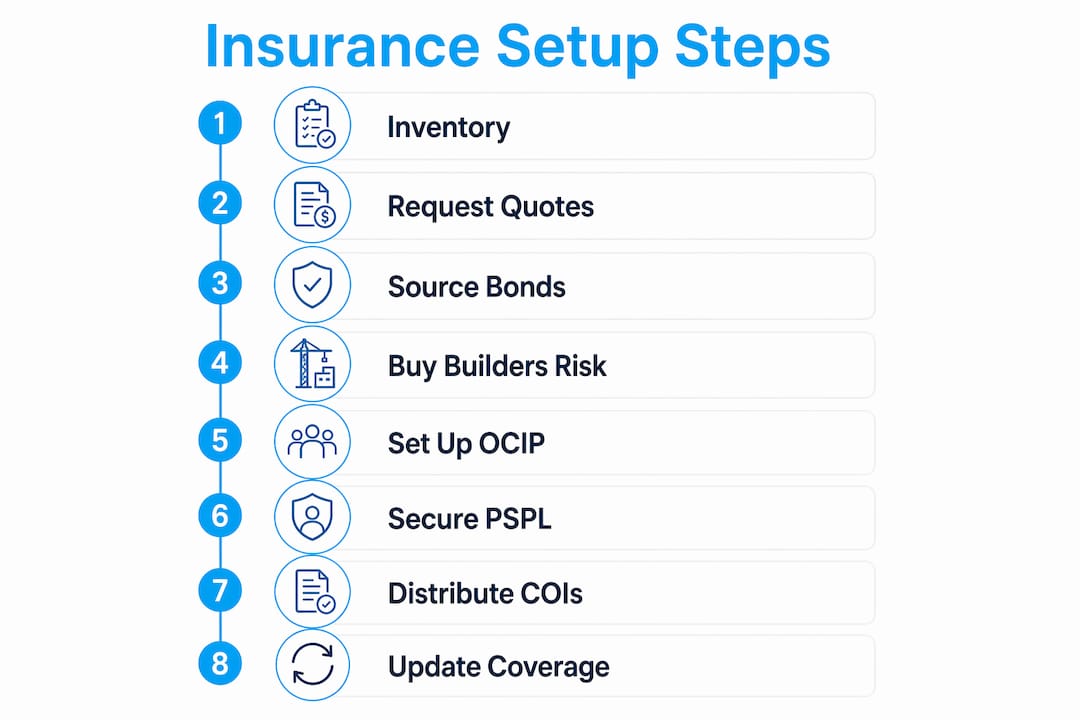
How to set up construction project insurance step by step
A solid construction project insurance setup follows a clear sequence. Skipping steps or rushing the process leads to coverage gaps, delayed project starts, and unhappy clients.

Step 1: Inventory your exposures
Before you contact a single carrier, map out your project’s risk profile. List every trade you perform, your total payroll by trade class, all owned vehicles, your tool and equipment inventory, and the project contract value. Review every prime and subcontract for indemnification language and insurance requirements. Contracts routinely require coverage levels above what you currently carry, and you need to know that before you sign.
Step 2: Get General Liability and Workers’ Comp quotes first
These two policies carry the largest premiums and the most carrier variability. Get quotes from multiple carriers, since appetite varies dramatically by trade and state. Once you have GL and Workers’ Comp placed, add Commercial Auto, Inland Marine, and an Umbrella policy. Bundling these with your GL carrier typically earns a multi-line discount.
Step 3: Source Surety Bonds separately
The surety market is specialized and operates differently from the commercial insurance market. Use a dedicated surety broker rather than your commercial lines broker. Your bonding capacity depends on your financial statements, credit history, and project backlog, so have those documents ready.
Step 4: Buy Builders Risk per project
Most Builders Risk policies are project-specific. Buy the policy before construction begins and confirm the coverage start date aligns with the contract commencement date. Large general contractors with a continuous pipeline of projects sometimes set up an annual blanket Builders Risk policy instead. For guidance on the application process, the Builders Risk application guide walks through the documentation requirements in detail.
Step 5: Set up OCIP enrollment before bidding (if applicable)
If you are the project owner or developer on a large project, OCIP setup must happen before bidding so subcontractors can factor out their own insurance costs when pricing their bids. Failure to do this means subcontractors will include insurance costs in their bids, and you lose the cost savings the OCIP was designed to produce. Work with a specialized broker and a program administrator to design the program, set coverage limits, and open enrollment.
Step 6: Secure PSPL for design-build projects
If your project uses a design-build delivery method, evaluate whether a Project-Specific Professional Liability policy makes sense. PSPL covers the entire design team under one policy, reducing disputes and eliminating gaps between individual practice policies. Engage a broker with design-build experience early, since PSPL policies require detailed underwriting of the project scope and team.
Step 7: Collect and distribute certificates of insurance
Once all policies are bound, collect COIs from every subcontractor before they start work. Confirm that additional insured endorsements and waivers of subrogation are in place as required by your contracts. Distribute your own COIs to the project owner, lender, and any other party the contract requires.
Pro Tip: Purchasing your insurance before you present your bid or sign a contract signals financial responsibility to owners and lenders. It is one of the fastest ways to build credibility on a new project relationship, and it removes a common source of project delays.
Step 8: Update coverage as the project evolves
Construction projects change. Scope expansions, change orders, and new subcontractors can all create coverage gaps if your policies are not updated. Review your coverage at every major project milestone: when the contract value increases, when new trades come on site, and when the project timeline extends. Notify your broker of any material changes promptly. For Builders Risk specifically, an increase in contract value above the original policy limit can leave you underinsured on a partial loss.
Key documents needed for a construction insurance application
Carriers ask for specific information to underwrite your policies accurately. Having these documents ready speeds up the process and reduces the chance of a coverage gap at project start.
- Signed prime contract or letter of intent: Confirms the project scope, contract value, and start date.
- Project description and site address: Carriers need to assess location-specific risks such as flood zone, wildfire exposure, and local litigation environment.
- Payroll breakdown by trade class code: Required for Workers’ Comp rating. Inaccurate payroll estimates lead to audit adjustments at policy expiration.
- Schedule of owned vehicles: Required for Commercial Auto. Include VINs, vehicle types, and primary drivers.
- Tool and equipment inventory with values: Required for Inland Marine coverage.
- List of subcontractors with their own COIs: Carriers want to see that your subs carry adequate coverage, which reduces your GL exposure.
- Loss runs for the past three to five years: Your claims history is one of the most important underwriting factors. Request loss runs from your current carrier before you shop for new coverage.
- Financial statements (for surety bonds): Surety underwriters review your balance sheet, income statement, and cash flow to set your bonding capacity.
How to assess and select an insurance provider
Not every carrier writes construction insurance, and not every broker understands the nuances of construction risk. Choosing the right partner matters as much as choosing the right policy.
Carrier financial strength: Check AM Best ratings before you bind coverage. An A-rated or better carrier is the standard for commercial construction. A carrier that becomes insolvent mid-project leaves you without coverage and potentially without recourse.
Construction expertise: Look for carriers and brokers who specialize in construction. They understand trade class codes, OCIP structures, PSPL underwriting, and the contract language that drives coverage requirements. A generalist broker may miss an endorsement that a construction specialist would catch automatically.
Claims handling reputation: Ask how the carrier handles construction claims specifically. Fast, fair claims handling matters when a loss happens mid-project and you need to keep work moving.
Broker vs. direct: An independent broker with access to multiple carriers can shop your account and find the best combination of coverage and price. A direct writer limits you to one carrier’s appetite and pricing. For complex projects with multiple policy types, an independent broker almost always produces a better outcome.
Common exclusions and limitations to watch for
Every construction policy has exclusions. Knowing them before a loss is far better than discovering them after.
- Faulty workmanship: General Liability typically does not cover the cost to repair or replace your own defective work. It covers damage your defective work causes to third-party property, but not the rework itself.
- Pollution events: Standard GL excludes pollution. Fuel spills, asbestos release, lead exposure, and sewage backup all require a separate Contractors Pollution Liability (CPL) policy. Most commercial contracts above a certain dollar threshold require CPL.
- Professional services: GL does not cover claims arising from professional design errors. That is what Professional Liability covers.
- Off-site equipment: Builders Risk typically covers property at the job site. Equipment stored at your yard or in transit may need separate Inland Marine coverage.
- Completed operations: Once a project is finished, standard Builders Risk ends. Make sure your GL policy includes completed operations coverage for claims that arise after project handover.
- Cyber events: Standard policies do not cover data breaches, ransomware, or cyber-related project delays. The 2024 AIA design-build documents now explicitly require Cyber Liability coverage on progressive design-build projects.
- OCIP off-site work: OCIP coverage is generally limited to on-site activities. Contractors must carry their own policies for work performed off the project site.
Tips for keeping your coverage current throughout the project
Insurance is not a one-time purchase. Active projects create new exposures as they progress, and your coverage needs to keep pace.
- Track contract value changes: Every approved change order that increases the contract value should trigger a review of your Builders Risk limit. Notify your broker when the total value rises above the original policy limit.
- Add new subcontractors to your COI tracking system: Every new sub that comes on site needs to provide a current COI before starting work. A lapse in a subcontractor’s coverage can expose you to liability.
- Review your Workers’ Comp payroll estimates mid-project: If your crew size grows significantly, your payroll estimate may be too low. An end-of-policy audit will catch the difference and result in an additional premium charge. Adjusting mid-term avoids a large surprise at audit.
- Extend Builders Risk if the project runs long: Most Builders Risk policies are written for a specific project duration. If the completion date slips, contact your broker to extend the policy before it expires. A gap in Builders Risk coverage, even for a few days, can be costly.
- Renew claims-made policies carefully: Professional Liability and PSPL are claims-made policies. If you let them lapse or switch carriers without purchasing tail coverage (an extended reporting period), you lose protection for claims filed after the policy ends, even if the error occurred while the policy was active.
Mfandtna helps you get the right construction coverage in place
Construction insurance is one of the more complex purchases a contractor or developer makes. The policy types overlap, the contract requirements vary by project, and the cost drivers are not always obvious until you are already in the middle of a bid.
Mfandtna is an independent insurance agency with over 30 years of experience placing coverage for contractors, developers, and project managers across multiple states. Because Mfandtna works with multiple carriers rather than a single company, you get real options, not a take-it-or-leave-it quote. Whether you need a straightforward Builders Risk policy for a single project or a full commercial coverage stack including Workers’ Comp, GL, Commercial Auto, and Inland Marine, Mfandtna can put together a program that fits your project scope and budget. The process starts with a conversation about your specific exposures, not a generic online form. Get a custom insurance quote and have a licensed advisor review your coverage needs before your next project breaks ground.
Key Takeaways
A complete construction project insurance setup requires at minimum General Liability, Workers’ Compensation, Builders Risk, Commercial Auto, and Inland Marine, with Surety Bonds, Professional Liability, and OCIP added based on project size, delivery method, and contract requirements.
| Point | Details |
|---|---|
| Start before breaking ground | Insurance must be bound and COIs distributed before work begins to meet legal and contract requirements. |
| Workers’ Comp is nearly universal | Required in most states, with rates set by trade class code and your experience modification rating. |
| Builders Risk costs 1–3% of contract value | Buy it per project and extend the policy if the completion date changes. |
| OCIP enrollment must precede bidding | Subcontractors need OCIP details to price their bids correctly; late setup eliminates cost savings. |
| Mfandtna builds your coverage stack | Mfandtna’s independent agency model gives contractors access to multiple carriers for a customized, competitively priced program. |