

Professional liability insurance is coverage that protects professionals from financial losses caused by claims of negligence, errors, or omissions in their services. Also called errors and omissions (E&O) insurance or, in medical fields, malpractice insurance, this policy covers the abstract financial harm a client suffers when your professional work falls short. It does not cover physical injuries or property damage. If you are a consultant, engineer, architect, accountant, or freelancer, this coverage is the financial safety net that stands between a client dispute and a career-ending lawsuit.
What is professional liability insurance and what does it cover?
Professional liability insurance protects defense costs and damages from claims alleging financial harm caused by errors, omissions, negligence, or failure to deliver professional services properly. That means the policy pays your attorney fees, court costs, and any settlement or judgment, up to your policy limits.
Common claims covered include:
- Negligent acts, such as an engineer recommending the wrong structural load calculation
- Errors and omissions, such as an accountant filing an incorrect tax return
- Failure to deliver services as promised, such as a consultant missing a critical project deadline
- Incorrect technical recommendations that cause a client financial loss
- Miscommunication that leads to a project being built to the wrong specifications
What professional liability does NOT cover:
- Bodily injury or property damage (those fall under general liability)
- Intentional wrongdoing or fraud
- Criminal acts
- Employment disputes between you and your staff
- Certain contractual liabilities you voluntarily assumed
Understanding these exclusions matters. A client who trips in your office is a general liability claim. A client who loses $200,000 because you gave bad financial advice is a professional liability claim. The two policies solve completely different problems.
Pro Tip: Read your policy’s definition of “professional services” carefully. If your work is not listed, a claim could be denied even if the incident looks like a clear E&O situation.
How does professional liability differ from general liability?
General liability insurance covers bodily injury and property damage, not professional service failures. That distinction creates a dangerous gap for professionals who assume one policy covers everything.

The core difference comes down to what triggers a claim. General liability responds to physical events. Professional liability responds to financial harm from a professional mistake. A contractor who drops a tool and breaks a client’s window files a general liability claim. An architect whose design flaw causes a building to fail files a professional liability claim.
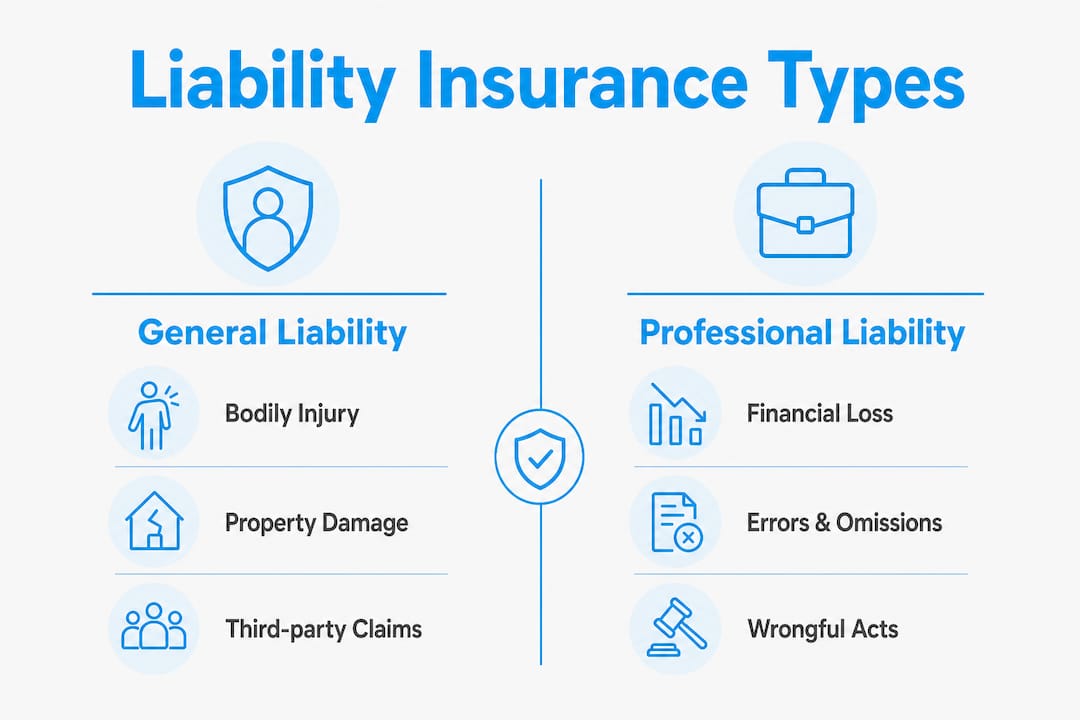
| Feature | General liability | Professional liability |
|---|---|---|
| Covers bodily injury | Yes | No |
| Covers property damage | Yes | No |
| Covers professional errors | No | Yes |
| Covers financial loss from advice | No | Yes |
| Uses standardized ISO policy forms | Yes | No |
| Required for most business licenses | Often | Rarely |
Standard GL policies explicitly exclude professional services, so professionals relying only on GL face uncovered claims for errors or omissions in their work. This is not a gray area. The exclusion is written directly into the policy language.
Professional liability policies are also unique and non-standardized. Unlike GL policies that use ISO standardized forms, professional liability policies vary by carrier. That makes comparing quotes harder. Two policies with the same premium can have very different coverage triggers, definitions of “wrongful act,” and exclusions.
Pro Tip: When comparing professional liability quotes, ask each carrier for their definition of “wrongful act” and their list of excluded services. Those two items reveal more about real coverage than the premium does.
Claims-made policies and retroactive dates: what professionals must know
Most professional liability policies are written on a claims-made basis. That means coverage depends on the policy being active when the claim is filed, not when the mistake happened. This is the single most misunderstood feature of professional liability insurance, and it catches professionals off guard at the worst possible time.
Here is how the timing works in practice:
- The retroactive date defines how far back your coverage reaches. Work done before this date is not covered, even if the claim is filed while your policy is active. If your retroactive date is january 1, 2023, a claim about work you did in december 2022 is not covered.
- The policy period is the window during which a claim must be filed. If your policy expires in june 2026 and a client files a claim in august 2026, you have no coverage unless you purchased tail coverage.
- Tail coverage, also called an extended reporting period (ERP), extends the time you can report claims after your policy ends. It is critical when you retire, change carriers, or close your business.
- Prior acts exclusions can appear when you switch carriers. A new insurer may exclude any work done before you joined them, creating a gap between your old policy’s retroactive date and your new one.
Canceling a professional liability policy without securing tail coverage can expose professionals to uncovered claims for past work. This is a frequent and costly oversight. A client can sue you years after a project ends, and without tail coverage, you pay out of pocket.
Claims-made policies include a retroactive date defining how far back coverage applies. Work done before that date may not be covered even if the claim is filed during the active policy period. Always confirm your retroactive date when you renew or switch carriers.
Timely reporting also matters. Failure to notify your carrier promptly can lead to claim denials. Some states require insurers to prove actual harm before denying coverage for late notice, but you should never test that rule.
What are the standard coverage limits and who requires this insurance?
The standard professional liability threshold for engineering firms is $1 million per claim with a $2 million aggregate limit. High-risk specialties or government contracts often require $2 million per claim and $4 million aggregate or more. These numbers set the floor, not the ceiling.
| Professional sector | Typical minimum limits | Common mandate source |
|---|---|---|
| Engineers and architects | $1M per claim / $2M aggregate | Client contracts, government procurement |
| IT consultants | $1M per claim / $1M aggregate | Client contracts |
| Accountants and CPAs | $1M per claim / $2M aggregate | State CPA boards, client contracts |
| Healthcare professionals | $1M per claim / $3M aggregate | Hospital credentialing, state licensing |
| Freelancers and consultants | $500K per claim / $1M aggregate | Client contracts |
Most state licensing boards do not legally require professional liability insurance for licensure. Mandates primarily arise from client contracts, employers, and government procurement policies. That surprises most professionals, who assume their licensing board requires it.
The practical reality is that clients, not regulators, drive the requirement. A government agency issuing a design contract will specify minimum limits in the solicitation. A large corporation hiring a consultant will require proof of coverage before signing. Without the right limits, you lose the contract.
Insurance experts stress that professional liability coverage is critical even for firms with strong quality control, because risks like client miscommunication and project delays can generate claims regardless of actual fault. Defense costs alone can reach six figures before a case is resolved.
How to select and maintain the right professional liability coverage
Choosing the right policy goes beyond finding the lowest premium. The policy terms determine whether you are actually covered when a claim arrives.
Key steps for selecting coverage:
- Review coverage triggers. Confirm whether the policy covers “wrongful acts” broadly or only specific listed services.
- Check the retroactive date. Request a retroactive date that matches the start of your professional career or the founding of your firm.
- Understand the aggregate limit. The aggregate is the total the insurer pays across all claims in a policy year. One large claim can exhaust it.
- Ask about defense costs. Some policies pay defense costs inside the limit, which reduces the money available for settlements. Others pay defense costs outside the limit, which is better for you.
- Plan for transitions. When you retire, change carriers, or close a business, purchase tail coverage immediately.
Maintaining continuous coverage without gaps is the single most effective risk management step you can take. A lapse of even one day can create a prior acts exclusion with a new carrier.
Pro Tip: If a client asks you to waive your right to limit liability in a contract, consult your insurer before signing. Some policy forms exclude claims arising from contracts where you assumed liability beyond what the law would otherwise impose.
For small business owners, professional liability often works alongside a business owner’s policy (BOP), which bundles general liability and property coverage. The two policies together close most coverage gaps for service-based businesses.
Key Takeaways
Professional liability insurance is the only policy that covers financial losses from professional errors, and no other standard business policy fills that gap.
| Point | Details |
|---|---|
| Core definition | Professional liability covers financial harm from errors, omissions, or negligence in professional services. |
| GL does not substitute | General liability explicitly excludes professional service failures, leaving a critical coverage gap. |
| Claims-made timing | Coverage depends on active policy status at claim filing, not when the mistake occurred. |
| Tail coverage is non-negotiable | Canceling a policy without tail coverage exposes you to uncovered claims for all past work. |
| Limits are contract-driven | Standard baseline is $1M per claim / $2M aggregate; client contracts and procurement set the real floor. |
Why I think most professionals underestimate this coverage
After more than 30 years working with professionals across Massachusetts and beyond, I have seen the same mistake repeat itself. A skilled, careful professional assumes that because they do good work, they will never face a claim. That assumption is wrong, and it is expensive.
The standard of care in professional liability law is not perfection. It is what a reasonably prudent professional would do in the same situation. That means a client can file a claim even when you did everything right. The claim itself costs money to defend, regardless of the outcome.
What I find most underappreciated is the long-tail nature of professional liability claims. A structural engineer can finish a project in 2022 and face a claim in 2028. An accountant can file a return in 2024 and get sued in 2027 when an audit reveals an error. Without a retroactive date that reaches back far enough, and without tail coverage at career transitions, those claims land on you personally.
The professionals who handle this well treat their coverage as a business asset, not a compliance checkbox. They review their retroactive dates annually, they negotiate coverage requirements in contracts before signing, and they call their agent before making any policy changes. That habit costs almost nothing and saves everything.
— Mike
Professional liability coverage options from Mfandtna
Mfandtna has helped professionals and business owners across Massachusetts find the right coverage for over 30 years. Whether you are a freelance consultant, a licensed engineer, or a growing firm navigating contract requirements, the right professional liability policy protects your income and your reputation.
Getting covered starts with understanding your specific exposure. Mfandtna works with multiple carriers to find policies that match your services, your contract requirements, and your budget. You can get an affordable quote today and have a real conversation about your coverage needs without any pressure. The right policy is out there. Mfandtna helps you find it.
FAQ
What is the definition of professional liability insurance?
Professional liability insurance is a policy that covers financial losses from claims of negligence, errors, or omissions in professional services. It pays defense costs, settlements, and judgments when a client alleges your work caused them financial harm.
What does professional liability insurance cover for freelancers?
Professional liability insurance for freelancers covers claims that your advice, designs, or deliverables caused a client financial loss. It pays legal defense costs and damages even if the claim is ultimately unfounded.
How does a claims-made policy work?
A claims-made policy covers claims filed while the policy is active, not when the incident occurred. If your policy lapses or is canceled, you need tail coverage to stay protected against claims from past work.
Is professional liability insurance required by law?
Most state licensing boards do not require professional liability insurance for licensure. Client contracts, employers, and government procurement policies are the primary sources of mandatory coverage requirements.
What is the difference between design professional liability and engineers professional liability?
Design professional liability and engineers professional liability are both forms of E&O insurance tailored to their respective fields. Both cover errors in plans, specifications, and technical recommendations, but policy forms and coverage triggers vary by carrier and specialty.