
General liability insurance is a business insurance policy that covers claims involving bodily injury, property damage, and personal and advertising injury caused by your business operations. Known formally as commercial general liability (CGL) insurance, this policy is the foundation of any small business or contractor’s risk management plan. Without it, a single lawsuit can drain your savings, force you to sell assets, or shut down your business entirely. Whether you run a landscaping company, a retail shop, or a construction crew, understanding what this coverage does and does not protect is the first step toward real financial security.
What does general liability insurance cover?
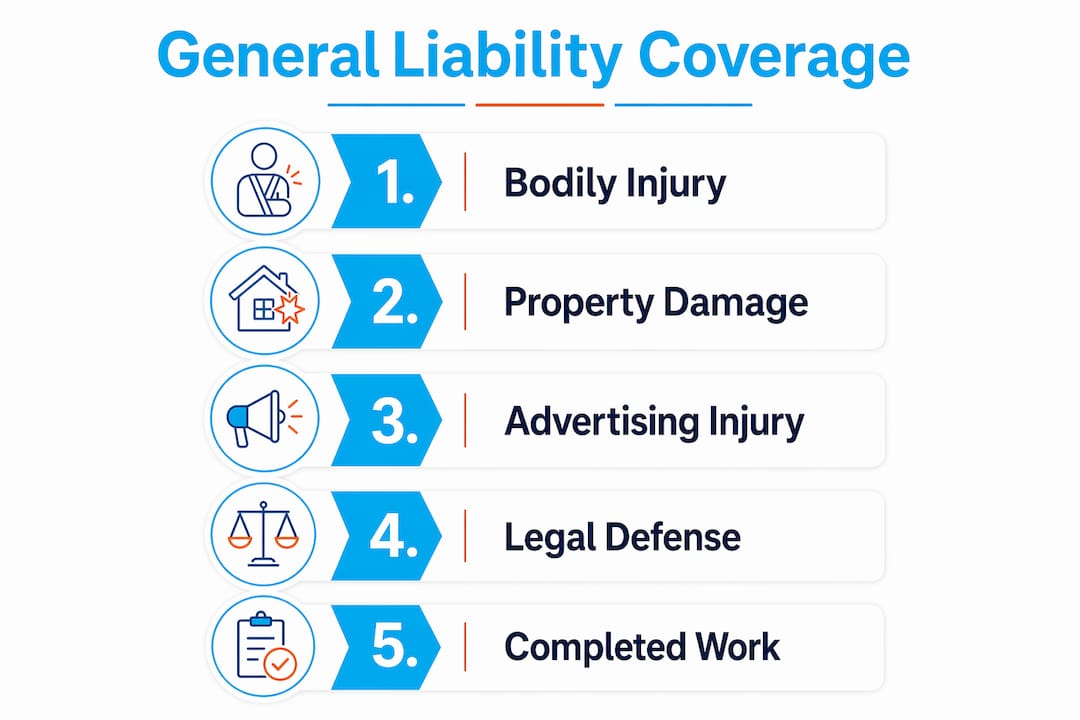
General liability insurance covers four core risk categories. Each one addresses a different way your business could cause harm to someone outside your company.
- Bodily injury: A customer slips on a wet floor at your job site and breaks their wrist. Your policy pays for their medical bills, lost wages, and any legal costs if they sue.
- Property damage: A plumber accidentally cracks a client’s tile floor during a repair. The policy covers the cost to fix or replace the damaged property.
- Personal and advertising injury: A competitor claims your ad campaign copied their slogan. Coverage applies to libel, slander, and copyright infringement claims arising from your marketing.
- Medical payments: This is a no-fault provision. If someone gets hurt on your property, the policy pays up to $5,000–$10,000 per incident without requiring them to prove you were negligent. That quick payout often prevents a minor injury from becoming a full lawsuit.
General liability also covers your completed work. If a contractor finishes a deck and it collapses three months later, products-completed operations coverage applies to claims that arise after the job is done. That protection matters because lawsuits rarely arrive the same week as the incident.
One of the most valuable features is the duty to defend. Most general liability policies pay for your legal defense, settlements, and court judgments even if the claim against you is eventually dismissed. Legal fees alone can reach tens of thousands of dollars before a case ever goes to trial.

Pro Tip: Ask your insurer whether defense costs are paid inside or outside your policy limits. If they count against your limits, a drawn-out lawsuit could exhaust your coverage before any settlement is reached.
What general liability insurance does NOT cover
The word “general” is misleading. This policy covers specific third-party risks. It does not cover everything that could go wrong in your business.
Common exclusions include:
- Professional errors: If a consultant gives bad advice that costs a client money, general liability does not apply. That requires professional liability insurance, also called errors and omissions (E&O) coverage.
- Employee injuries: Workers’ compensation is a separate, legally required policy in most states. General liability does not cover injuries your employees sustain on the job.
- Your own property and vehicles: Damage to your tools, equipment, or company truck requires commercial property insurance or commercial auto coverage.
- Pollution: Contractors who work with chemicals or hazardous materials need a pollution liability endorsement. Standard CGL policies exclude most pollution-related claims.
- Intentional acts: If you or an employee deliberately cause harm, the policy will not pay.
These gaps are exactly why most small businesses need more than one policy. A business owner’s policy (BOP) bundles general liability with commercial property coverage at a lower combined rate. Contractors often add workers’ compensation and a commercial auto policy on top of that.
Pro Tip: Review your exclusions list every year. As your business grows into new services or locations, new risks appear that your original policy may not address.
How much does general liability insurance cost?
General liability insurance costs vary widely based on your industry, business size, and claims history.
| Business Type | Estimated Annual Cost |
|---|---|
| Low-risk solo operator (e.g., consultant, photographer) | $300–$600 |
| Mid-risk service business (e.g., cleaning, retail) | $600–$2,000 |
| High-risk trade business (e.g., roofing, electrical) | $2,000–$8,500 |
These cost ranges reflect the real spread between a freelance graphic designer and a roofing contractor. The difference comes down to how likely your work is to cause injury or property damage.
The most common policy structure uses standard limits of $1 million per occurrence and $2 million aggregate. The per-occurrence limit is the maximum paid for a single claim. The aggregate limit is the total the insurer will pay across all claims during the policy year. Once you hit the aggregate, you are on your own for the rest of the year.
Several factors push your premium up or down:
- Industry risk level: Roofers pay more than bookkeepers.
- Revenue and payroll: Higher revenue signals more exposure.
- Location: States with higher litigation rates charge more.
- Claims history: A prior lawsuit raises your rate significantly.
- Deductible: A higher deductible lowers your premium but increases your out-of-pocket cost per claim.
Policy type also matters. Occurrence-based policies cover any event that happens during the policy period, regardless of when the claim is filed. Claims-made policies only cover claims filed while the policy is active. Most small businesses benefit from occurrence-based coverage because it protects against late-reported claims without requiring continuous coverage from the same insurer.
Why is general liability insurance required for small businesses?
General liability insurance is not always legally required at the state level. However, it is contractually required in most professional situations.
Situations where you will need proof of coverage include:
- Signing a commercial lease: Most landlords require a certificate of insurance (COI) before handing over keys.
- Working with clients: General contractors, property managers, and corporate clients routinely require subcontractors to carry at least $1 million in coverage before starting any job.
- Applying for a business license: Some municipalities require proof of general liability as part of the licensing process.
- Securing a business loan: Lenders often require coverage to protect the collateral backing the loan.
Many landlords, lenders, and clients require proof of coverage before signing contracts or permitting work to begin. That requirement is not bureaucratic red tape. It protects both parties from financial exposure.
Operating without coverage puts your business assets directly at risk. A single slip-and-fall lawsuit can result in legal fees, a settlement, and a court judgment that exceeds what most small businesses hold in cash. Without insurance, those costs come directly out of your business accounts, equipment, and in some cases, personal assets.
A certificate of insurance (COI) is the document that proves your coverage is active. Managing COIs effectively is a key part of staying compliant with contract requirements and maintaining good business relationships. You should be able to produce an updated COI within 24 hours of any client request.
How to choose the right general liability policy
Selecting the right policy comes down to matching your coverage to your actual risk profile. Follow these steps to make a sound decision.
- Identify your risk exposure. List the ways your business could injure someone or damage their property. A landscaper has different risks than a software consultant.
- Choose occurrence-based coverage. For most small businesses, occurrence-based policies provide more consistent protection than claims-made policies, especially when switching insurers.
- Set appropriate limits. Start with the standard $1 million per occurrence and $2 million aggregate. If your contracts require higher limits, adjust accordingly.
- Add additional insured endorsements. Clients and landlords often require you to name them as additional insureds on your policy. This extends your coverage to protect them from claims arising from your work.
- Request your COI immediately after binding. Do not wait until a client asks. Have it ready before you need it.
- Review your policy annually. As your revenue grows or your services change, your coverage needs change too. An annual review with your agent prevents gaps from forming quietly.
For a detailed look at coverage examples by industry, reviewing real-world scenarios helps you understand exactly how your policy would respond in practice.
Key takeaways
General liability insurance is the foundational policy every small business and contractor needs to protect against third-party claims of bodily injury, property damage, and advertising injury.
| Point | Details |
|---|---|
| Core coverage areas | Bodily injury, property damage, advertising injury, and medical payments are the four main protections. |
| Key exclusions | Professional errors, employee injuries, and your own property require separate policies. |
| Typical cost range | Low-risk businesses pay $300–$600 annually; high-risk trades pay up to $8,500. |
| Standard policy limits | Most small businesses carry $1 million per occurrence and $2 million aggregate. |
| When it is required | Landlords, clients, and lenders routinely require proof of coverage before contracts begin. |
What I’ve learned after 30 years of placing business insurance
Business owners make one mistake more than any other. They incorporate their business and assume that legal structure fully shields them from financial loss. It does not. Incorporation limits personal liability but leaves your business assets, equipment, accounts, and reputation fully exposed to lawsuits. I have seen contractors lose everything they built over a single job-site accident that their LLC did nothing to prevent.
The second mistake is treating general liability as a checkbox. Owners buy the cheapest policy they can find, file it away, and never look at it again. Then a claim arrives and they discover their aggregate limit was exhausted by a prior claim they forgot about, or their policy excluded the exact type of work that caused the loss. Coverage is only useful if it actually applies when you need it.
My honest advice: treat your insurance review the same way you treat your annual tax filing. Set a date, sit down with your agent, and go through every policy you carry. Check your limits against your current revenue. Confirm your COIs are current. Ask whether any new services you added this year fall outside your existing coverage. That one-hour conversation every year is the cheapest risk management tool available to any small business owner.
— Mike
Get affordable general liability coverage through Mfandtna
Mfandtna has helped small businesses and contractors across Massachusetts and beyond secure the right coverage at a price that fits their budget for over 30 years.
Whether you need a basic general liability policy or a full package that includes commercial property and workers’ compensation, Mfandtna’s team will walk you through your options without pressure. You can get a free quote online in minutes and speak directly with an experienced agent who understands the risks contractors and small business owners face every day. For a full overview of what coverage your business needs, visit the small business insurance guide on the Mfandtna website.
FAQ
What is general liability insurance in simple terms?
General liability insurance is a business policy that pays for claims involving bodily injury, property damage, or advertising injury caused by your operations. It also covers your legal defense costs if someone sues your business.
What does commercial general liability insurance cover?
Commercial general liability (CGL) insurance covers third-party bodily injury, property damage, personal and advertising injury, medical payments, and completed operations claims. It does not cover your employees, your own property, or professional errors.
How much general liability insurance does a small business need?
Most small businesses and contractors start with $1 million per occurrence and $2 million aggregate coverage. Clients or landlords may require higher limits, so always check your contract requirements before purchasing a policy.
Is general liability insurance required by law?
General liability insurance is not universally required by state law, but it is contractually required by most landlords, clients, and lenders before they will work with your business. Some municipalities also require it as part of the business licensing process.
What is the difference between general liability and professional liability?
General liability covers physical risks like bodily injury and property damage. Professional liability, also called errors and omissions insurance, covers financial losses caused by mistakes or negligence in the services you provide. Most service-based businesses need both.