
A commercial insurance agent is a licensed professional who helps small business owners secure, manage, and maintain the insurance coverage needed to protect their operations, assets, and employees. The role of insurance agent commercial clients depend on goes far beyond selling a policy. These professionals assess business risks, source coverage from carriers, bind protection, and advocate for clients when claims arise. Understanding what a commercial agent actually does helps you work with one more effectively and get better coverage for your money.
What are the core duties of a commercial insurance agent?
Commercial insurance agents handle a wide range of responsibilities every day. The industry term for this work is “commercial lines production,” and it covers everything from prospecting new clients to managing existing accounts through renewals and endorsements.
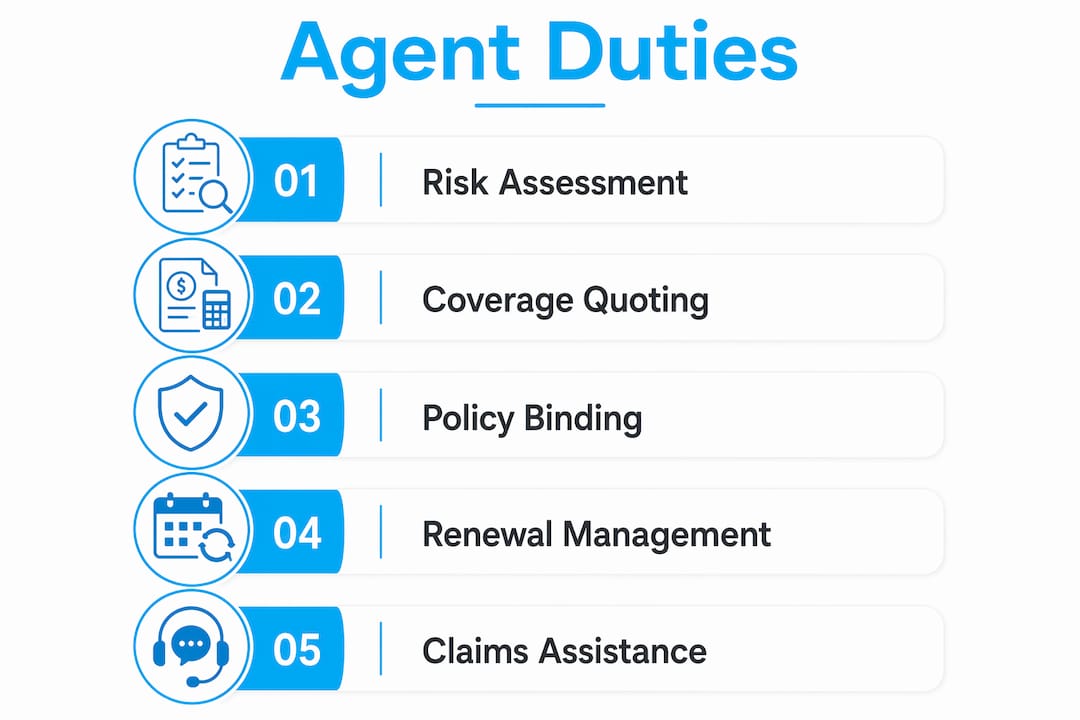
The core commercial insurance agent duties include:
- Risk assessment: Reviewing your business operations, property, vehicles, payroll, and claims history to identify exposures that need coverage.
- Quoting: Using carrier platforms to pull multiple quotes and compare coverage terms, limits, and premiums across insurers.
- Binding coverage: Issuing a binder, which is a temporary legal contract that gives your business immediate protection during the typical one to two week processing window before the formal policy is finalized.
- Renewals and endorsements: Reviewing your policy each year, adjusting coverage as your business grows, and processing mid-term changes like adding a new vehicle or location.
- Cross-selling: Recommending additional products such as cyber liability, umbrella policies, or builders risk insurance when your exposure warrants it.
Commercial sales processes involve proactive prospecting in 68% of cases, meaning agents spend significant time identifying new clients, not just waiting for referrals. That proactive outreach is what keeps a healthy book of business growing.
Pro Tip: Ask your agent to walk you through the binder before your formal policy arrives. Knowing exactly what is and is not covered during that gap period prevents surprises.

Agents split their time roughly equally between sales and service. 61% of agents work inside brokerages or agencies, while 14% are self-employed. That structure shapes how much time they can dedicate to your account, so it pays to ask upfront.
How does a commercial insurance agent help during a claim?
The agent’s most valuable work often happens after a loss, not before it. Business owners are frequently surprised to learn that claims advocacy is where a skilled agent earns their keep most visibly.
“Agents who write significant premium volume with a carrier have internal leverage that individual policyholders simply do not have. They can escalate disputed claims, push for faster adjuster assignments, and ensure the policy language is applied correctly on your behalf.”
When you file a claim, your agent can help you gather and organize the required documentation, submit it correctly the first time, and follow up directly with claims adjusters. That follow-up matters because delayed or incomplete submissions are the most common reason claims drag on. Agents also interpret complex policy language for you, translating exclusions and conditions into plain terms so you understand what the insurer will and will not pay.
The distinction between an agent and a broker matters here. A broker has a fiduciary duty to the client, while an agent technically represents the carrier. In practice, experienced agents act as strong client advocates regardless of that legal distinction, using their carrier relationships to resolve disputes faster than you could on your own.
Pro Tip: Keep your agent’s direct phone number saved separately from your policy documents. When a loss happens, you want to reach a person, not a call center.
Captive vs. independent agents: what’s the difference for your business?
The type of agent you work with directly affects how many coverage options you can access. Understanding this distinction helps you choose the right business insurance advisor for your situation.
| Feature | Captive agent | Independent agent |
|---|---|---|
| Carrier access | Single insurer only | Multiple carriers |
| Product range | Limited to one company’s offerings | Broad, can compare across markets |
| Carrier expertise | Deep knowledge of one carrier’s products | Broad market knowledge |
| Compensation | Base salary plus commission | Commission from multiple carriers |
| Best for | Businesses with straightforward risks | Businesses with complex or unique exposures |
Captive agents represent a single insurer and develop deep expertise in that carrier’s products, underwriting appetite, and claims process. That depth can be valuable if your business fits neatly into that carrier’s preferred risk profile. The limitation is that if your risk does not fit, the captive agent has no alternative to offer you.
Independent agents represent multiple carriers and can compare coverage options across the market. This flexibility is particularly useful for businesses with unusual exposures, mixed operations, or a claims history that makes some carriers hesitant. Mfandtna operates as an independent agency, which means clients get access to multiple markets rather than a single carrier’s products.
Both agent types must hold a state-issued property and casualty license. Most states also require continuing education credits to maintain that license, which keeps agents current on coverage changes and emerging risks like cyber liability.
What steps should you take when working with a commercial agent?
Getting the most from your agent relationship requires preparation on your end. The quality of information you provide directly shapes the quality of coverage you receive.
-
Gather your loss runs. Loss runs are your claims history reports from prior carriers. Providing detailed loss runs gives underwriters the full picture and materially improves your quote competitiveness. Incomplete information leads to declined quotes or inflated premiums.
-
Write a clear risk narrative. Describe your business operations in plain language: what you do, where you do it, how many employees you have, and what your biggest exposures are. Underwriters reward agents who submit complete, detailed applications with better pricing and more flexible terms.
-
Request a coverage gap analysis. Instead of asking only for the cheapest quote, ask your agent to identify gaps in your current coverage. Businesses that discover gaps become committed clients once they understand the exposure they were carrying unknowingly.
-
Schedule annual stewardship meetings. Review your policy before each renewal, not just the premium. Your business changes every year, and your coverage should reflect that. Bring updated payroll figures, new equipment lists, and any changes to your operations.
-
Be transparent about your claims history. Hiding prior claims rarely works and always backfires. Agents who know your full history can frame it accurately for underwriters, which produces better outcomes than surprises during the underwriting review.
Commercial lines renewal retention rates run at 90–95% for well-managed accounts. That number reflects how much value a good agent relationship delivers over time.
Key Takeaways
A commercial insurance agent’s value extends well beyond the initial policy sale, covering risk assessment, claims advocacy, and annual coverage management that protects your business at every stage.
| Point | Details |
|---|---|
| Core duties span the full policy lifecycle | Agents assess risk, quote, bind, manage renewals, and cross-sell coverage as your business grows. |
| Claims advocacy is the highest-value service | Agents use carrier relationships to escalate disputes and interpret policy language on your behalf. |
| Agent type affects your coverage options | Independent agents access multiple carriers; captive agents offer depth with one insurer. |
| Preparation improves your outcomes | Providing complete loss runs and a clear risk narrative leads to better quotes and fewer coverage gaps. |
| Annual reviews protect against gaps | Reviewing coverage each renewal cycle keeps your policy aligned with your actual business operations. |
What I’ve learned about agents who actually move the needle
After years of watching how commercial insurance relationships play out, the agents who consistently deliver the most value share one trait: they act as consultants first and salespeople second. The best ones call you before your renewal, not after. They flag a coverage gap you did not know existed, or they warn you that a carrier is tightening its appetite in your industry before your renewal hits.
The misconception I see most often is that insurance is a commodity where price is the only variable worth comparing. That thinking leads business owners to switch agents every year chasing a lower premium, and it costs them dearly when a claim hits and they have no relationship to lean on. The agent who knows your business, your claims history, and your carrier contacts is worth far more than the one who saved you $200 on your annual premium.
Market awareness is the other underrated skill. Emerging risks like cyber exposures and shifting reinsurance costs require agents to stay current on market conditions. An agent who is not tracking these changes cannot advise you accurately. When you are evaluating an agent, ask them what coverage changes they have seen in your industry in the past 12 months. The answer tells you everything.
The agents who build durable client relationships do it by offering coverage gap analyses rather than bidding on price alone. That approach wins business and keeps it. If your current agent has never offered you one, that is worth noting.
— Mike
How Mfandtna supports small business owners with commercial coverage
Small business owners in Massachusetts and beyond need an agent who understands their specific exposures, not a one-size-fits-all policy.
Mfandtna is an independent insurance agency with over 30 years of experience helping businesses find coverage that fits their actual operations. The agency offers free business insurance quotes across commercial lines including general liability, commercial auto, and builders risk. Because Mfandtna works with multiple carriers, you get real market comparisons rather than a single carrier’s offering. If you want to know where your current coverage has gaps, the team at Mfandtna can walk you through a coverage review and help you make informed decisions about your protection. Reach out to get started with a no-pressure consultation.
FAQ
What does a commercial insurance agent do?
A commercial insurance agent assesses business risks, sources and binds coverage, manages renewals, and advocates for clients during claims. Their work covers the full policy lifecycle, not just the initial sale.
How are commercial insurance agents paid?
Most commercial agents earn commissions paid by the carrier and built into your premium. Commission rates typically fall between 10–15% of the policy premium, meaning clients are not billed directly.
What is the difference between a captive and an independent agent?
A captive agent represents one insurer and offers that carrier’s products only. An independent agent works with multiple carriers and can compare coverage options across the market to find the best fit for your business.
Why does a coverage gap analysis matter more than price shopping?
A coverage gap analysis identifies exposures your current policy does not cover, which price shopping alone misses entirely. Businesses that discover gaps often find they were carrying significant uninsured risk without realizing it.
How do I become a commercial insurance agent?
Becoming a commercial agent requires passing your state’s property and casualty licensing exam and completing any required pre-licensing coursework. Most states also require ongoing continuing education to maintain the license and stay current on coverage changes.