

Your homeowners insurance premium is the annual cost you pay to keep your home protected against fire, theft, weather damage, and liability claims. Most homeowners overpay simply because they never revisit their policy. The good news: you can lower your homeowners insurance premium through a handful of targeted moves that reduce your risk profile and align your coverage with what you actually need. Three factors drive the biggest savings: your deductible level, your credit score, and how often you shop for better rates. Understanding each one puts real money back in your pocket.
How does raising your deductible reduce your insurance premium?
Your deductible is the amount you pay out of pocket before your insurer covers a claim. The higher your deductible, the lower your annual premium. This trade-off is one of the fastest ways to cut your insurance bill without changing your coverage.
Raising your deductible from $1,000 to $2,000 saves homeowners an average of $336 per year. On a $3,417 annual premium, that drop to $3,081 represents roughly 9% in savings. That is real money returned to your budget every year you do not file a claim.
The catch is straightforward: you need liquid savings to cover that higher deductible if something goes wrong. Before you raise your deductible, ask yourself these questions:
- Do you have at least $2,000 in an accessible savings account?
- Could you cover the deductible without going into debt?
- Is your home in a low-risk area where large claims are unlikely?
- Have you filed a claim in the past three years?
If you answered yes to the first two and no to the last one, raising your deductible is likely the right call. If your emergency fund is thin, doubling your deductible creates financial risk that outweighs the premium savings.
Pro Tip: Set your deductible at the highest amount you could comfortably pay from savings within 30 days. That number is your personal ceiling, not a number to push past.
Why bundling home and auto insurance policies can lower your premiums
Bundling means purchasing your homeowners and auto insurance from the same insurer. Insurers reward this loyalty with a multi-policy discount because managing two policies under one account reduces their administrative costs and lowers their risk of losing you as a customer.

Bundling home and auto yields average discounts of 23%, with potential savings of $1,010 annually. Discounts across insurers range from 10% to 40%, depending on the carrier and your specific policies. That range matters because not every bundle deal is a good deal.
Before you commit to a bundle, compare these factors:
- The combined bundled premium versus the sum of two separate policies from different carriers
- Whether the bundled insurer offers the coverage limits you need on both policies
- Any loyalty perks, such as a disappearing deductible or accident forgiveness, included in the bundle
- The financial strength rating of the insurer, which signals their ability to pay claims
You can learn more about how bundling works and whether it makes sense for your specific situation before making a switch. The key is to compare the full picture, not just the headline discount percentage.
What role does your credit score play in homeowners insurance costs?
Insurers in most states use a credit-based insurance score to predict the likelihood that you will file a claim. This score differs from your standard FICO score but draws from the same underlying credit data. A lower score signals higher risk to the insurer, and that risk gets priced into your premium.
Homeowners with poor credit pay up to $4,869 more annually than those with excellent credit for comparable coverage. That gap is not a rounding error. It is the single largest premium variable most homeowners can control over time.
Improving your credit score takes consistency, but the steps are concrete:
- Pay every bill on time, since payment history carries the most weight in credit scoring
- Keep your credit card balances below 30% of your available limit
- Avoid opening multiple new credit accounts in a short period
- Check your credit report annually for errors and dispute any inaccuracies
Pro Tip: Ask your insurer to re-run your credit-based insurance score after 12 months of credit improvement. Many carriers will adjust your premium mid-term if your score has moved significantly.
Note that a small number of states restrict or prohibit the use of credit scores in insurance pricing. Check your state’s insurance commissioner website to confirm the rules where you live.
How can home improvements and risk mitigation reduce insurance premiums?
Insurers price your premium based on the likelihood and cost of a future claim. When you reduce the risk of damage to your home, you reduce that likelihood. That reduction translates directly into discounts.
The most effective upgrades fall into four categories:
- Roof replacement or reinforcement. A new impact-resistant roof reduces wind and hail damage risk. Many insurers offer specific credits for Class 4 impact-resistant shingles.
- Storm shutters and wind-resistant windows. These protect against hurricane and severe storm damage, which is a major driver of claims in coastal and southern states.
- Security systems and smart home devices. Many insurers offer discounts for monitored alarm systems, smart smoke detectors, and leak detection sensors. These devices reduce the chance of theft, fire, and water damage claims.
- Updated electrical, plumbing, and HVAC systems. Older systems are a leading cause of fire and water damage. Upgrading them signals lower risk to your insurer.
Retrofitting for high-wind protection saves $6 in long-term damage for every $1 invested and triggers insurance discounts. That return makes mitigation investments financially sound beyond just the premium savings.
One important caveat: some home additions increase your premium rather than reduce it. Adding a swimming pool, a trampoline, or a wood-burning stove raises your liability and fire risk. Talk to your agent before starting any major renovation so you understand the insurance impact in advance.
Why regularly shopping around and reviewing your policy saves money
Most homeowners set up their policy once and forget it. That habit is expensive. Insurers adjust their pricing models constantly, and the rate you locked in three years ago may no longer be competitive.
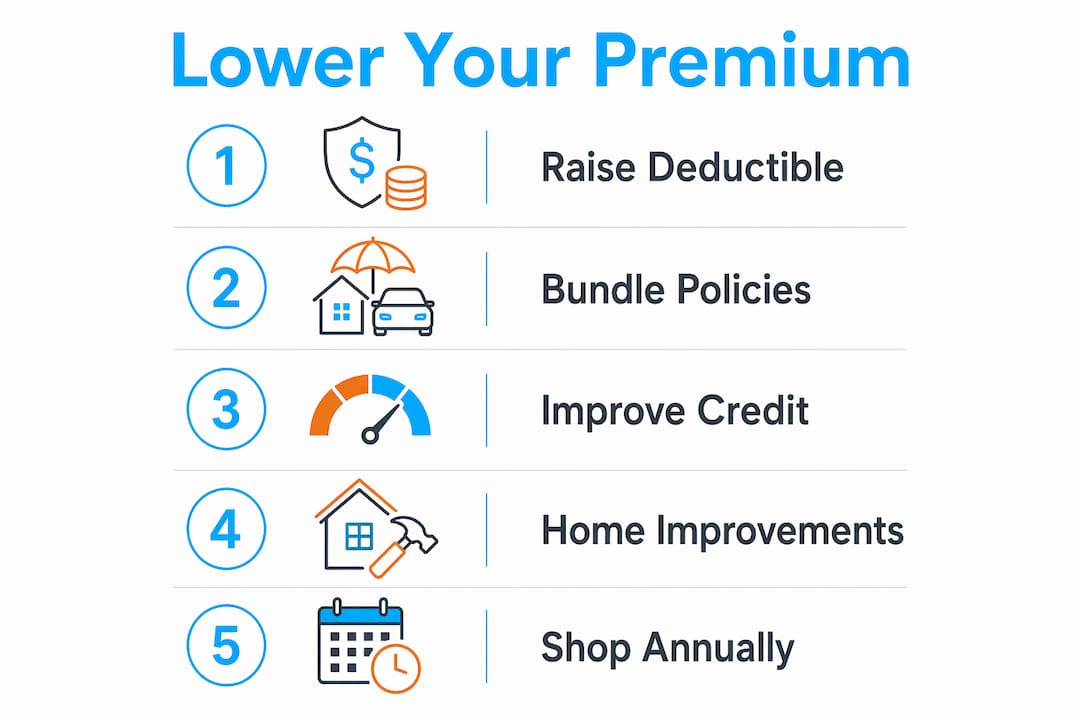
Annual quotes can vary by as much as $4,416 for identical dwelling coverage. The average homeowner who switches insurers saves $482 per year. Those numbers make the case for shopping around every 12 months.
A thorough annual review covers more than just price. It also checks whether your coverage still fits your home:
- Has your home’s replacement cost changed due to rising construction costs?
- Did you complete renovations that increased your home’s value?
- Did you remove a risk factor, such as a trampoline or old wiring, that could earn a discount?
- Are you still carrying coverage for items you no longer own?
Insurance premiums align with replacement cost, not market value. Land is excluded from coverage, so insuring your home for its full market value means you are likely overpaying. An annual policy review with your agent catches this kind of overcoverage before it costs you another year of inflated premiums.
One more factor to weigh carefully: your claims history. Filing small claims frequently adds an average of $544 per year to your premium. Insurers track claims for 3–5 years, and repeat claimants face surcharges that can erase any payout benefit from minor claims. Pay small repairs out of pocket and reserve your policy for genuine losses.
Key takeaways
Lowering your homeowners insurance premium requires raising your deductible, improving your credit, bundling policies, upgrading your home’s risk profile, and shopping for better rates every year.
| Point | Details |
|---|---|
| Raise your deductible | Moving from $1,000 to $2,000 saves an average of $336 per year, but requires liquid savings. |
| Bundle home and auto | Bundling with one insurer yields average discounts of 23%, saving up to $1,010 annually. |
| Improve your credit score | Poor credit can cost up to $4,869 more per year compared to excellent credit for the same coverage. |
| Upgrade home safety features | Security systems, updated wiring, and wind-resistant upgrades reduce claim risk and earn discounts. |
| Shop and review annually | Quote variations reach $4,416 for identical coverage; switching saves an average of $482 per year. |
What I’ve learned after years of reviewing homeowners policies
Most homeowners focus on the premium number and ignore the policy mechanics that drive it. That is the wrong place to start.
The single most overlooked move I see is the deductible adjustment. Homeowners carry a $500 or $1,000 deductible out of habit, not strategy. Raising it to $2,500 while keeping a matching emergency fund in a high-yield savings account is a straightforward win. You self-insure the small stuff and let the policy do what it is designed for: covering catastrophic losses.
The other mistake I see constantly is filing small claims. A leaky pipe that costs $800 to fix is not worth a claim. That one filing can add $544 per year to your premium for up to five years. You would pay more in surcharges than the claim ever covered. Pay it out of pocket and protect your claims-free record.
Reading your homeowners insurance policy carefully is also non-negotiable. Replacement cost coverage and actual cash value coverage are not the same thing. Actual cash value pays you the depreciated worth of damaged items. Replacement cost pays what it actually costs to replace them. The premium difference between the two is usually modest. The payout difference after a major loss is not.
My honest advice: treat your homeowners policy like a financial product, not a utility bill. Review it every year, ask your agent hard questions, and never assume last year’s rate is still the best available.
— Mike
How Mfandtna helps you find affordable homeowners coverage
Mfandtna has spent over 30 years helping homeowners in Massachusetts and beyond find coverage that fits their budget and their actual risk profile. The team reviews your current policy, identifies gaps or overcoverage, and compares rates across multiple carriers to find the best fit.
Whether you want a full policy review or a fresh quote, Mfandtna makes the process straightforward. The agency specializes in homeowners insurance solutions that balance cost and protection, and can walk you through every discount you qualify for. If you are ready to see what you could save, get a free quote and let the Mfandtna team do the comparison work for you.
FAQ
How much can I save by raising my deductible?
Raising your deductible from $1,000 to $2,000 saves an average of $336 per year. The savings grow larger as you increase the deductible further, but you must have the funds available to cover it if you file a claim.
Does my credit score really affect my homeowners insurance rate?
Yes. In most states, insurers use a credit-based insurance score to set premiums. Homeowners with poor credit can pay nearly $4,869 more annually than those with excellent credit for the same coverage.
Is it worth filing a small homeowners insurance claim?
Filing small claims is rarely worth it. One claim adds an average of $544 per year to your premium, and insurers track your claims history for 3–5 years. Pay minor repairs out of pocket to protect your claims-free discount.
How often should I shop for a new homeowners insurance rate?
Shop for quotes every 12 months. Annual quote comparisons can reveal price differences of up to $4,416 for identical coverage, and the average homeowner who switches saves $482 per year.
What home improvements lower homeowners insurance costs?
Upgrades that reduce claim risk earn the biggest discounts. These include impact-resistant roofing, monitored security systems, smart leak detectors, and updated electrical or plumbing systems. Talk to your agent before renovating to confirm which improvements qualify for a discount with your specific carrier.