

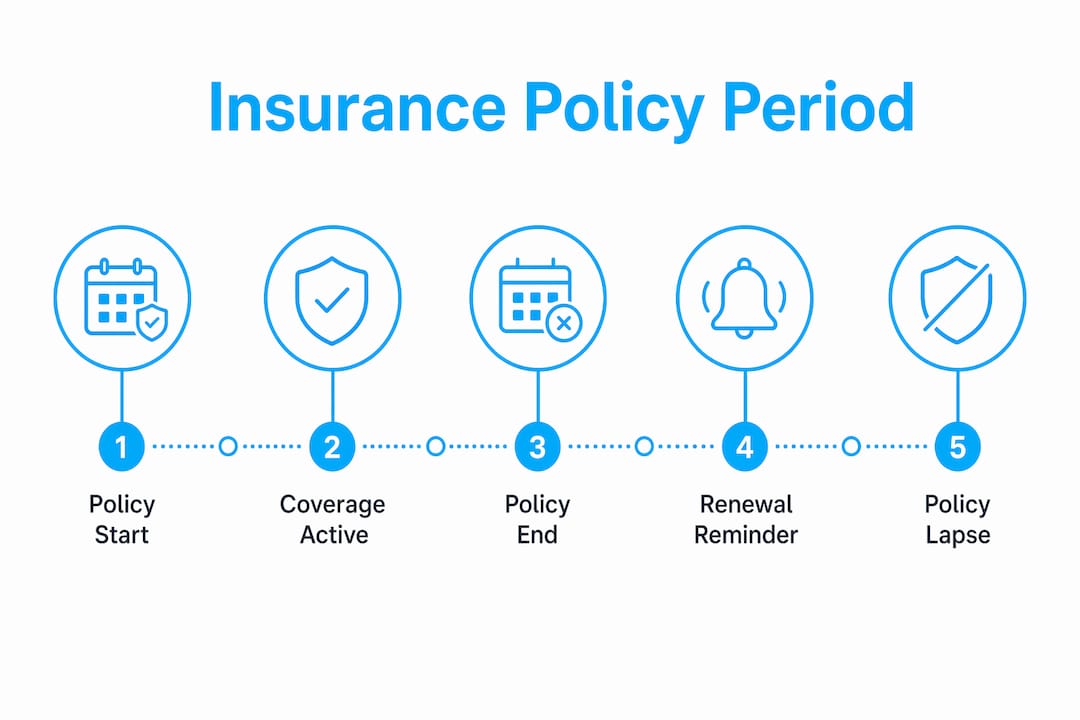
An insurance policy period is defined as the exact start and end date range during which your insurance coverage is legally active. Most personal insurance policies run for 12 months, while auto insurance commonly uses 6-month terms. Knowing your policy period is not just paperwork detail. It determines whether a claim gets paid, whether your lender stays satisfied, and whether you pay more at your next renewal. This guide breaks down the insurance policy period explained in plain terms, so you can manage your coverage with confidence.
What are the standard durations of insurance policy periods?
An insurance policy period is the active coverage window within a contract, while the “policy term” refers to the contractual length of the agreement. The two phrases are related but not identical. Confusing them leads to real mistakes when you are comparing quotes or switching carriers.
Standard durations follow a clear pattern across personal lines:
- 12-month periods are the industry default for homeowners insurance and most personal liability policies. Annual policy terms align with common budget cycles and regulatory reporting requirements, which explains why they dominate personal insurance.
- 6-month periods are standard for personal auto insurance. Shorter terms let insurers adjust rates more frequently based on your driving record and claims history.
- Commercial and specialty policies vary widely. A builders risk policy may run for the duration of a construction project, which could be 3 months or 3 years. Marine cargo policies can cover a single voyage lasting days.
The choice of term length involves real tradeoffs. Shorter policy terms offer flexibility to adjust coverage as your life changes but require more frequent underwriting reviews. Longer terms lock in your premium rate and reduce administrative friction. If your insurer raises rates mid-market, a locked 12-month rate protects you until renewal.
Pro Tip: If your insurer offers a multi-year term option, compare the locked rate against projected market increases before deciding. Rate stability often outweighs the flexibility of shorter terms for homeowners in high-risk areas.

How do you read your policy period on insurance documents?
Your declarations page is the single most important document in your insurance file. It lists your policy period start date, expiration date, named insured, coverage limits, and deductibles on one or two pages. Every other document in your policy package refers back to it.
Here is what each date on your declarations page means:
- Effective date: The exact moment your coverage begins, often at 12:01 AM on the listed date.
- Expiration date: The exact moment your coverage ends. Coverage does not automatically continue past this date.
- Issue date: The date the insurer generated the document. This is not the same as the effective date and does not affect coverage.
- Mid-term change date: If you added a driver or increased a limit during the policy period, a new declarations page shows the date that change took effect.
Checking your declarations page immediately upon receipt is critical. Catching an error before a claim occurs is far easier than disputing it after one. Errors in your name spelling, property address, or coverage limit can all affect a claim outcome.
| Document field | What it means | Why it matters |
|---|---|---|
| Effective date | Coverage start, typically 12:01 AM | Determines when protection begins |
| Expiration date | Coverage end date | Claims after this date are not covered |
| Issue date | Document generation date | Does not equal coverage start |
| Mid-term change date | Date an endorsement took effect | Shows updated coverage within the period |
Pro Tip: Set a calendar reminder 60 days before your expiration date. That window gives you time to shop, compare, and avoid a last-minute lapse.
What happens if there is a lapse between insurance policy periods?
A coverage lapse is any gap between the end of one policy period and the start of the next. Even a single day without coverage creates real consequences that follow you for years.
- Higher premiums at renewal. Insurers treat a lapse as a risk signal. Coverage lapses harm future insurability and result in higher premiums at your next application. A lapse of 30 days or more can push you into a higher-risk pricing tier.
- Lender complications. If you carry a mortgage, your lender requires continuous insurance coverage. A lapse can trigger your lender to purchase force-placed insurance on your behalf, which is typically far more expensive and covers only the lender’s interest, not yours.
- Claim denial for incidents during the gap. Any loss that occurs during a lapse period is not covered. A fire, theft, or accident on day two of a gap is entirely your financial responsibility.
- Cancellation before expiration. Policy cancellation can happen before the stated expiration date if a premium payment is missed. Insurers send a notice, but the grace period is short. Missing that notice creates an unintended lapse.
The most common cause of a coverage lapse is not a deliberate choice. It is a missed renewal notice, an expired credit card on autopay, or a policy that renewed at a higher premium the policyholder did not expect. Staying proactive with your renewal dates and payment methods is the single most effective way to maintain continuous coverage.
Coordinate your new policy start date to begin the same day your old policy expires. Never assume a renewal is automatic without confirming it in writing.
How do mid-term changes affect your coverage?
Mid-term changes are modifications made to your policy before the expiration date. Common examples include adding a new vehicle to your auto policy, increasing your homeowners dwelling limit after a renovation, or adjusting your deductible. Each change triggers a specific process.
Key facts about mid-term changes:
- A new declarations page is issued showing the change effective date. This date is not your original policy start date. It is the date the modification took effect.
- The original policy period does not change. Mid-term policy modifications come with an updated declarations page, but the expiration date of the original policy remains the same.
- Premium adjustments are prorated. If you add coverage mid-term, you pay only for the remaining portion of the policy period, not a full new term.
- Claims are handled based on the effective date of each change. If a loss occurs before a mid-term change took effect, the original coverage terms apply, not the updated ones.
Understanding this distinction protects you from surprises at claim time. Review every updated declarations page you receive, not just the one issued at the start of the policy period. Errors in mid-term endorsements are just as consequential as errors in the original document.
How do you manage your policy period for better coverage and cost?
Managing your insurance coverage timeline actively saves money and prevents gaps. Most families treat insurance as a set-and-forget purchase. That approach works until it does not.
Practical steps to manage your policy period well:
- Review your declarations page at every renewal, not just when you first buy a policy. Limits, deductibles, and listed property can drift out of date as your life changes.
- Keep expired policies for 3–7 years. Old insurance documents serve as evidence for latent liability claims and influence future underwriting decisions. A contractor’s liability claim can surface years after a project ends.
- Choose your term length based on your situation. If you are renovating, moving, or expecting major life changes, a shorter term gives you flexibility. If your home is in a high-risk area and rates are rising, locking a 12-month rate makes financial sense.
- Confirm your new policy is active before canceling the old one. Never cancel a policy based on a verbal confirmation. Get the new declarations page in hand first.
- Watch for mid-term cancellation notices. Insurers are required to notify you before canceling, but the window can be as short as 10 days in some states.
Pro Tip: Store your current declarations page as a PDF in a cloud folder you can access from your phone. If your home is damaged or your car is in an accident, you will have your policy number, insurer contact, and coverage details instantly available.
Key takeaways
Your insurance policy period is the legally binding coverage window that determines whether every claim, lender requirement, and renewal decision works in your favor.
| Point | Details |
|---|---|
| Policy period vs. policy term | The period is your active coverage window; the term is the contractual length of the agreement. |
| Standard durations | Homeowners policies run 12 months; auto policies commonly run 6 months. |
| Lapse consequences | Even a one-day gap raises future premiums and can void lender-required coverage. |
| Mid-term changes | Endorsements issue a new declarations page but do not change the original expiration date. |
| Document retention | Keep expired policies for 3–7 years to support latent claims and future underwriting. |
Why I think most families underestimate the policy period
After working in insurance for over 30 years, the pattern I see most often is not fraud or bad faith. It is inattention. Families receive their declarations page, file it away, and never look at it again until something goes wrong.
The confusion between “policy term” and “policy period” is more consequential than it sounds. I have seen homeowners assume their coverage was active because they paid their premium, not realizing their policy had lapsed three weeks earlier due to a billing error. The loss was real. The coverage was not there.
What surprises most people is how little it takes to fix this. Reading your declarations page once a year, confirming your renewal, and keeping your payment method current covers the vast majority of lapse scenarios. The families who do this consistently almost never face a coverage gap.
The other habit I recommend is keeping old policies. Most people shred them. But a general liability claim from a home renovation can surface two or three years later, and your old policy is the only proof of what coverage was in place at the time. That document can be worth thousands of dollars in a dispute.
Proactive insurance management is not complicated. It is mostly about knowing what dates matter and checking them before a problem forces you to.
— Mike
How Mfandtna helps you stay covered through every policy period
Mfandtna has helped individuals and families in Massachusetts and beyond manage their insurance coverage for over 30 years. Whether you need to review your homeowners policy dates, understand your auto renewal timeline, or make sure your coverage is continuous through a major life change, Mfandtna’s team makes the process straightforward.
Getting a personalized insurance quote through Mfandtna takes the guesswork out of choosing the right policy period and term length for your situation. The team explains your declarations page in plain language, flags potential gaps before they become problems, and helps you find coverage that fits your budget. You can also visit the homeowners insurance FAQ for answers to common questions about policy periods, renewals, and coverage continuity.
FAQ
What is an insurance policy period?
An insurance policy period is the exact date range during which your insurance coverage is legally active, defined by a start date and an expiration date on your declarations page. Any claim for a loss that occurs outside this window is not covered.
How long is an insurance policy valid?
Most homeowners insurance policies are valid for 12 months, while auto insurance policies commonly run for 6 months. Commercial and specialty policies vary based on the type of risk and agreement.
What happens if my policy lapses between periods?
A lapse between policy periods results in no coverage for any loss during the gap and typically leads to higher premiums at your next renewal. Lenders may also purchase force-placed insurance on your behalf, which is more expensive and covers only their interest.
Does a mid-term change extend my policy period?
No. A mid-term endorsement issues a new declarations page with the change effective date, but the original policy expiration date stays the same. Your policy period length does not change when you add or remove coverage.
How do I find my policy period on my documents?
Your policy period appears on the declarations page, typically at the top of the first page, listed as the effective date and expiration date. Reading your declarations page carefully when you receive it helps you catch any errors before a claim occurs.