

General liability insurance for contractors is defined as a commercial policy that pays for third-party bodily injury, property damage, and legal defense costs arising from your contracting work. Without it, a single lawsuit can wipe out years of business income. Most commercial clients require proof of coverage before you set foot on a job site, and many states tie it directly to your contractor’s license. This guide breaks down exactly what the coverage includes, what it costs, how to choose the right limits, and where contractors commonly get burned by policy gaps.
What does general liability insurance cover for contractors?
Contractor general liability, formally called Commercial General Liability (CGL) insurance, covers four core areas. Understanding each one prevents costly surprises when a claim hits.
Third-party bodily injury and property damage are the foundation. If a visitor trips over your equipment and breaks an arm, or your crew accidentally cracks a client’s floor, the policy pays for medical bills, repairs, and any resulting lawsuit. Legal defense costs are paid outside of the policy limits, which matters enormously. Construction litigation can run into six figures before a verdict is reached.

Completed operations coverage protects you after a job is finished. If a deck you built collapses six months later and injures someone, this portion of the CGL policy responds. Products liability covers materials or components you supply that later cause harm.
What the policy does not cover is just as important:
- Employee injuries: Workers’ compensation handles those, not general liability.
- Your own tools and equipment: You need inland marine or equipment floater coverage for that.
- Faulty workmanship itself: The policy does not pay to redo your bad work. It pays for resulting damage. For example, if a leaky pipe you installed ruins a client’s hardwood floors, the floor damage is covered. Fixing the pipe is not.
- Professional liability: Design errors or specification mistakes require a separate Errors and Omissions (E&O) policy. See the difference between these two policies before assuming one covers the other.
One nuance contractors frequently miss involves the “your work” exclusion. The standard CGL policy excludes damage caused by your own faulty workmanship. However, the subcontractor exception restores coverage when the defective work was performed by a subcontractor you hired. That exception can be stripped out by an endorsement, so you must read your policy carefully and verify it is intact.
Pro Tip: Ask your broker to confirm in writing that the subcontractor exception has not been removed from your policy by endorsement before signing any subcontract.
What factors influence the cost of contractor liability insurance?
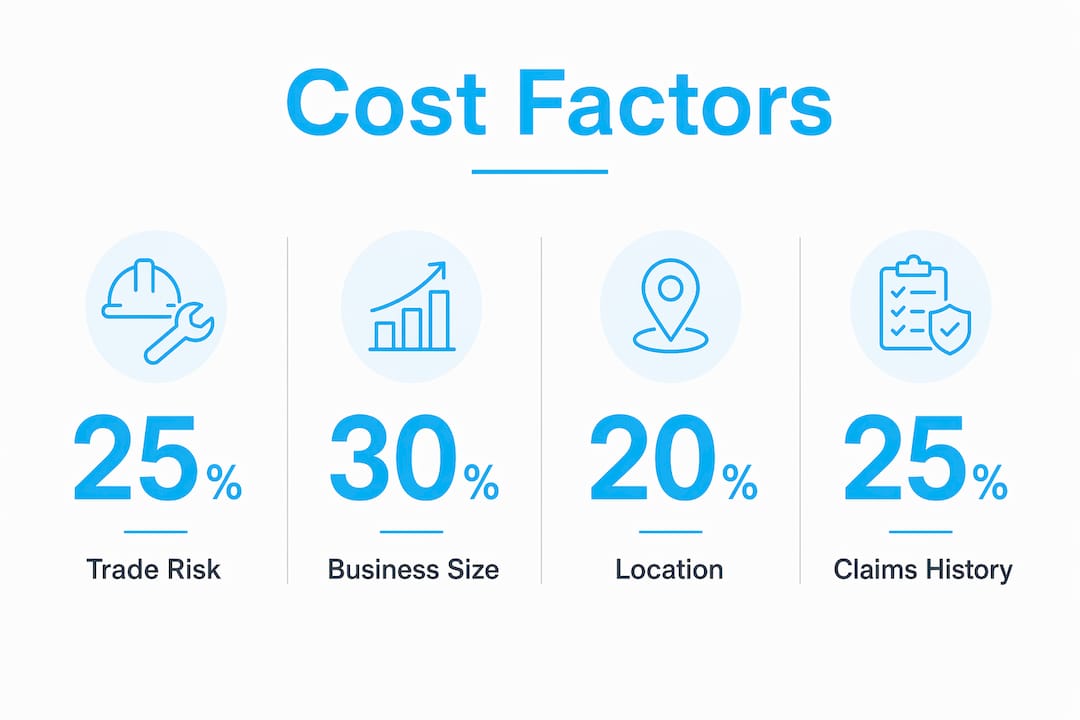
Premium costs vary widely based on your trade, business size, location, and claims history. The table below shows typical annual ranges.
| Contractor Type | Typical Annual Premium |
|---|---|
| Solo contractor (low-risk trade) | $480–$1,860 |
| Small firm, 1–4 employees | ~$4,041 average |
| High-risk trades (roofing, demolition) | Significantly higher |
| Large or specialized contractors | Can exceed $26,000/month |
Premium ranges reflect the real financial exposure tied to each trade. A roofer works at height with heavy materials and faces far greater injury risk than an interior designer. Insurers price that difference directly into the premium.
Your claims history carries serious weight. Contractors with no claims over five or more years may qualify for discounts of 15–25%. That is a meaningful reduction on a policy that already costs thousands per year.
Location also affects cost. States with aggressive litigation environments, higher medical costs, or strict contractor licensing laws push premiums up. Massachusetts, California, and New York consistently rank among the more expensive states for construction liability policies.
The number of employees and your annual revenue are additional rating factors. Insurers treat payroll as a proxy for exposure. More workers on more job sites means more chances for something to go wrong.
Pro Tip: Bundle your general liability policy with a commercial auto or workers’ compensation policy from the same carrier. Many insurers offer multi-policy discounts that reduce your total insurance spend.
How to determine the right coverage limits for your contracting business
Coverage limits define the maximum the insurer will pay per claim and in total for the policy year. Choosing too low a limit is one of the most common and costly mistakes contractors make.
-
Check your state licensing requirement first. Many states mandate a minimum of $500,000 per occurrence to hold a contractor’s license. That floor is a starting point, not a finish line.
-
Match what commercial clients require. Most commercial project owners require at least $1 million per occurrence and $2 million aggregate. Larger projects routinely demand $2 million to $5 million per occurrence. If your limits fall short, you lose the contract.
-
Understand per-occurrence vs. aggregate limits. The per-occurrence limit is the maximum paid for any single claim. The aggregate is the total paid across all claims in a policy year. A $1 million/$2 million structure means one claim can consume up to $1 million, and all claims combined cannot exceed $2 million.
-
Think through your worst-case scenario. Picture your largest active project. If a structural failure injured multiple people or destroyed expensive equipment, what would the total exposure look like? That mental exercise usually reveals whether your current limits are realistic.
-
Consider an umbrella policy for larger jobs. A commercial umbrella policy sits above your CGL limits and activates when a claim exhausts the underlying coverage. For contractors working on projects valued above $1 million, an umbrella is often the most cost-effective way to reach the higher limits clients demand. Review commercial real estate insurance requirements to understand what large project owners typically mandate.
How to shop for and secure contractor liability insurance
Getting the right policy requires more than finding the lowest quote. Follow these steps to compare coverage accurately.
-
Gather your business profile. Know your trade classification, annual revenue, payroll, number of employees, and the types of projects you take on. Insurers use all of this to rate your policy.
-
Compare online carriers and traditional brokers. Online-first carriers can issue policies and certificates of insurance quickly, which works well for solo contractors who need coverage fast. Traditional brokers offer more customization and claims support, though certificate issuance typically takes 1–3 business days. Brokers with construction expertise are especially valuable for matching coverage to your actual scope of work.
-
Confirm the key policy components. Before you bind coverage, verify the per-occurrence and aggregate limits, check that the subcontractor exception is intact, and review all endorsements for coverage removals.
-
Read the declarations page and endorsement schedule. The declarations page summarizes your coverage. The endorsement schedule lists every modification to the standard policy form. Relying on a quote summary without reading endorsements is how contractors discover denied claims after the fact.
-
Obtain your certificate of insurance before work begins. A COI is required by almost all commercial clients before a project starts. It shows your coverage limits, insurer name, and policy dates. Many clients also require an additional insured endorsement, which extends your policy’s protection to cover them in certain situations.
-
Document safety protocols. Maintaining written safety programs, incident logs, and training records signals to insurers that you manage risk actively. That documentation supports lower premiums and strengthens your position if a claim is disputed.
“Reviewing the actual policy declarations and all endorsements is critical because relying on high-level quote summaries can leave contractors unaware of vital exclusions or coverage removals until a claim is denied.”
What are common exclusions contractors overlook in liability policies?
Policy exclusions are where coverage quietly disappears. Knowing the most common ones protects you from a denied claim at the worst possible moment.
-
Care, custody, or control exclusion: If a client’s property is in your possession and you damage it, the standard CGL policy does not cover that loss. An antique fixture you remove and accidentally break is a classic example. Inland marine or a specific endorsement fills this gap.
-
Professional liability exclusion: CGL policies do not cover claims arising from design decisions, specifications, or professional advice. If you also provide design services, a separate E&O policy is required.
-
“Your work” exclusion without the subcontractor exception: As noted above, this exclusion denies coverage for your own faulty workmanship. If an endorsement has removed the subcontractor exception, you have no coverage for defect claims involving subcontractors either.
-
Contractual liability exclusions: Many policies limit coverage for liability you assume under a contract, such as broad indemnity clauses. Review any indemnity language in your client contracts against your policy’s contractual liability coverage.
-
Endorsements that remove coverage: Insurers sometimes add exclusionary endorsements for specific hazards, such as mold, silica dust, or certain types of work. These appear in the endorsement schedule and are easy to miss on a quick review.
Pro Tip: Have a construction-focused insurance broker review your policy endorsements annually. Coverage that was adequate when you started may have gaps as your business grows or your project types change.
A contractor who assumes coverage based on the policy name alone, rather than the actual policy language, is the most common profile in denied construction claims. Read the full document, not just the summary page. For a deeper look at how coverage examples play out in real contracting scenarios, that resource walks through specific claim situations in detail.
Key Takeaways
General liability insurance for contractors is the single most critical business protection you can carry, and the right policy requires matching limits, endorsements, and exclusions to your actual scope of work.
| Point | Details |
|---|---|
| CGL covers third-party claims | Bodily injury, property damage, and legal defense costs are the core protections. |
| Know your exclusions | The “your work” exclusion, care/custody exclusion, and professional liability gap are the most costly surprises. |
| Match limits to contracts | Most commercial clients require $1M per occurrence and $2M aggregate at minimum. |
| Cost depends on trade and history | Solo contractors pay $480–$1,860 annually; a clean claims record can cut premiums by 15–25%. |
| Read every endorsement | Quote summaries miss coverage removals; only the full policy and endorsement schedule reveal the real coverage. |
Why I always tell contractors to read the endorsements first
After working with contractors across Massachusetts and beyond for over three decades, the pattern I see most often is this: a contractor buys a policy, assumes they are covered, and finds out otherwise when a claim is denied. The denial almost always traces back to an endorsement they never read.
The subcontractor exception issue is the one that surprises people most. Contractors assume that because they hired a licensed sub, any defect claim is covered. That assumption is wrong if an endorsement removed the exception. I have seen this cost contractors tens of thousands of dollars out of pocket on jobs where they thought they were fully protected.
My honest recommendation is to work with a broker who specializes in construction, not a generalist. A construction-focused broker knows which endorsements to watch for, which carriers handle contractor claims fairly, and how to structure your policy as your business grows. Reviewing your coverage once a year, especially when you take on larger projects or add employees, is not optional. It is the difference between a policy that works and one that looks good on paper.
— Mike
How Mfandtna helps contractors get the right coverage
Mfandtna has spent over 30 years helping contractors across Massachusetts and multiple states secure commercial insurance that actually fits their work.
Whether you are a solo tradesperson or running a small crew, Mfandtna provides a personalized coverage assessment to match your policy limits, endorsements, and exclusions to your real-world exposure. Getting a quote is straightforward, and the team can issue certificates of insurance quickly so you never lose a job over a paperwork delay. For contractors who want coverage that holds up when it counts, get a free insurance quote and connect with an advisor who understands the construction industry. Mfandtna also covers commercial general liability examples in detail for contractors who want to see how policies apply to specific job scenarios.
FAQ
Do contractors need general liability insurance?
Yes. Most states require it for licensing, and virtually all commercial clients require proof of coverage before work begins. Without it, a single third-party injury or property damage claim can result in a lawsuit that exceeds your business assets.
What is a general contractor liability policy?
A general contractor liability policy is a Commercial General Liability (CGL) insurance contract that covers third-party bodily injury, property damage, and legal defense costs arising from contracting operations, including completed work.
What are the most common general liability exclusions for contractors?
The most common exclusions are the “your work” exclusion for faulty workmanship, the care/custody/control exclusion for client property in your possession, and the professional liability exclusion for design-related claims. Each requires separate coverage or a specific endorsement to address.
How much does general liability insurance cost for a contractor?
Solo contractors typically pay $480–$1,860 per year, while small firms with 1–4 employees average around $4,041 annually. High-risk trades like roofing pay significantly more, and costs rise with payroll, project size, and claims history.
What coverage limits should contractors carry?
The practical standard for most commercial work is $1 million per occurrence and $2 million aggregate. Larger projects often require $2 million to $5 million per occurrence, and an umbrella policy is the most cost-effective way to reach those higher thresholds.