
A Business Owner’s Policy, commonly called a BOP, is a packaged commercial insurance policy that combines general liability, commercial property, and business interruption coverage into one affordable plan for small businesses. If you have ever wondered what is business owners policy and whether it applies to your operation, the short answer is: it probably does. The Insurance Services Office (ISO) standardized the BOP form to make bundled coverage accessible to businesses with fewer than 100 employees and under $5 million in annual revenue. That combination of simplicity and savings is why BOPs have become the go-to starting point for small business protection across the country.
What coverages are included in a Business Owner’s Policy?
A BOP bundles three core protections that most small businesses need from day one. Each coverage addresses a different category of risk, and together they form a solid foundation for your business insurance program.
General liability coverage pays for third-party claims of bodily injury, property damage, and advertising injury. If a customer slips on your floor or you accidentally damage a client’s property during a service call, this coverage responds. You can read a full breakdown of how this works in our guide to general liability for small businesses.
Commercial property insurance covers your building, equipment, inventory, furniture, and other physical assets against fire, theft, vandalism, and certain weather events. Whether you own or lease your space, this coverage protects the tools that keep your business running. For a deeper look at what qualifies as a covered asset, see our overview of commercial property insurance.

Business interruption insurance replaces lost operating income when a covered event forces you to close temporarily. Standard coverage typically runs 12 months, with some carriers offering extensions to 18 or 24 months. That means your rent, payroll, and loan payments stay covered while you rebuild. You can explore how this works in detail through our guide to business income insurance.
Beyond the three core coverages, many carriers allow you to add endorsements for data breach, equipment breakdown, or hired and non-owned auto liability. These add-ons customize your BOP without requiring a separate policy for each risk.
Key coverage inclusions at a glance:
- General liability: Third-party bodily injury, property damage, personal and advertising injury
- Commercial property: Buildings, equipment, inventory, and business personal property
- Business interruption: Lost income, ongoing fixed expenses, and temporary relocation costs
- Optional endorsements: Cyber liability, equipment breakdown, hired auto, and more
- Common exclusions: Flood, earthquake, professional errors, workers’ compensation, and commercial auto
Pro Tip: Ask your agent specifically about replacement cost versus actual cash value for your property coverage. Replacement cost pays what it costs to buy new; actual cash value deducts depreciation. The difference can be thousands of dollars at claim time.
How does a Business Owner’s Policy work, and who qualifies?
The BOP underwriting process is designed to be fast for low-risk businesses. Carriers use class codes assigned by the ISO to evaluate your industry, size, and risk profile before issuing a quote. Clean profiles get approved quickly. Businesses outside standard parameters face manual review and longer timelines.
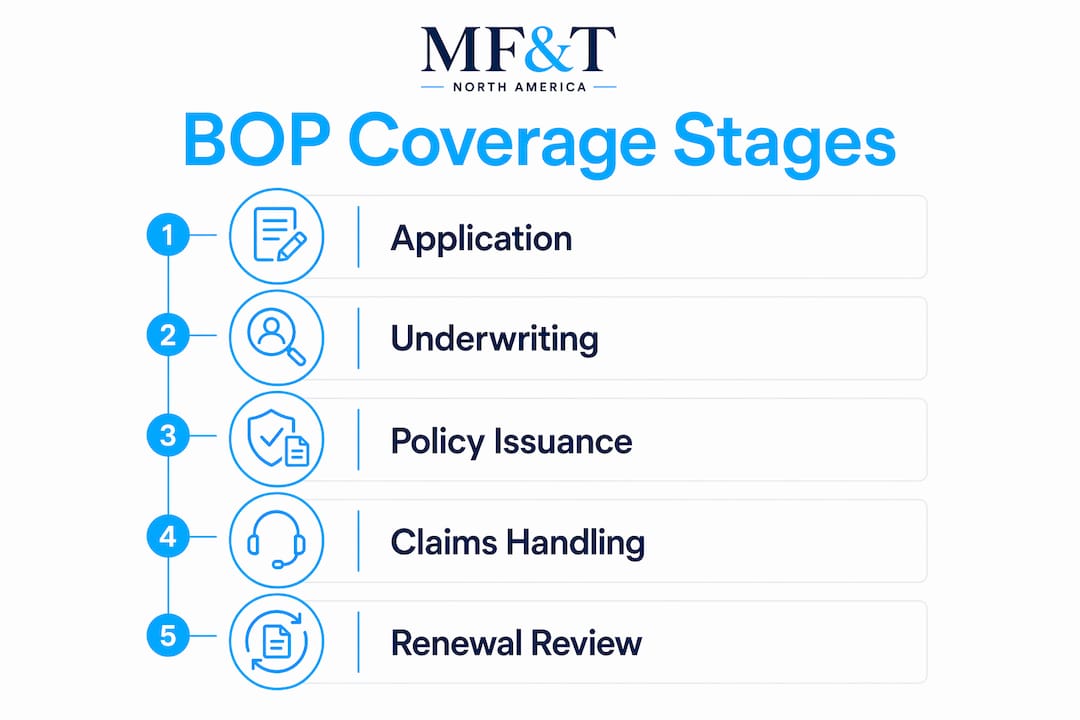
Standard eligibility benchmarks are straightforward. Businesses with fewer than 100 employees and less than $5 million in annual revenue typically qualify, though individual carriers set their own thresholds. Meeting those numbers does not guarantee approval. Carriers use strict class codes, meaning your industry risk profile matters as much as your headcount.
Here is how the qualification process typically works:
- Submit basic business information: Industry type, number of employees, annual revenue, and location.
- Carrier assigns a class code: This code determines your risk tier and whether a BOP is even available for your business type.
- Underwriter reviews your profile: Low-risk businesses get fast approvals; complex or borderline cases go to manual review.
- Quote is issued: Your premium reflects your class code, coverage limits, location, and any endorsements you select.
- Policy binds: Coverage starts on the agreed effective date, and you receive a certificate of insurance.
Businesses in specialized manufacturing, hazardous chemical handling, or high-risk contracting are often excluded from BOP eligibility even if they meet the size and revenue thresholds. Those businesses typically need a Commercial Package Policy (CPP), which allows more flexible underwriting for complex or higher-risk operations.
Pro Tip: If a carrier declines your BOP application, ask specifically which class code disqualified you. That information helps you shop with carriers who have broader appetites for your industry.
What does a Business Owner’s Policy typically cost?
A BOP saves small businesses 10–15% compared to buying general liability, commercial property, and business interruption insurance as separate policies. That discount reflects the carrier’s ability to spread risk across a bundled product rather than underwriting each coverage independently.
Actual premiums vary significantly by industry and risk profile. Here is a general range for common business types:
| Business Type | Estimated Annual BOP Cost |
|---|---|
| Solo low-risk operator (consultant, freelancer) | $500–$1,200 |
| Small retail shop | $800–$2,500 |
| Restaurant or food service | $2,500–$6,000 |
| General contractor | $1,500–$4,500 |
These annual cost ranges reflect base premiums before endorsements or higher coverage limits. Your actual quote will shift based on several factors:
- Business size: More employees and higher revenue push premiums up.
- Location: Urban areas and states with higher litigation rates cost more.
- Coverage limits: Higher liability limits and broader property coverage increase your premium.
- Claims history: Prior losses signal higher risk and raise your rate.
- Industry risk class: A yoga studio pays far less than a roofing contractor for the same coverage limits.
To manage costs without cutting coverage, review your property values annually and adjust limits to match current replacement costs. Bundle only the endorsements you actually need, and maintain a clean claims record. Working with an independent agent gives you access to multiple carriers so you can compare rates without sacrificing coverage quality.
What are common misconceptions and critical gaps in a BOP?
The biggest mistake small business owners make is treating a BOP as a complete insurance solution. A BOP does not include workers’ compensation, commercial auto, or professional liability by default. Each of those requires a separate policy or endorsement. Assuming otherwise leaves real gaps that can cost you far more than the premium you saved.
“Many businesses mistakenly assume BOP is a catch-all policy, which causes gaps in coverage especially in workers’ compensation, commercial auto, and professional liability risks. Those gaps only become visible at claim time, when it is too late to fix them.”
Property coverage carries its own hidden risk. Replacement cost limits within a BOP may be capped below actual replacement costs, leaving you with a significant out-of-pocket expense after a major loss. A business owner who insures $150,000 worth of equipment at a $100,000 limit discovers that gap only after a fire. By then, the shortfall is real money, not a policy detail.
Common BOP coverage gaps to watch:
- Workers’ compensation: Required by law in most states for any business with employees. Not included in a BOP.
- Commercial auto: Vehicles used for business need a separate commercial auto policy. Personal auto policies exclude business use.
- Professional liability (E&O): Covers claims of negligence or errors in professional services. Architects, consultants, and IT firms need this separately.
- Flood and earthquake: Standard property coverage excludes both. Separate policies or endorsements are required.
- Cyber liability: Basic BOP forms rarely include meaningful data breach coverage. A standalone endorsement or policy is worth considering for any business that stores customer data.
The underlying structure of a BOP reinforces why gaps matter. A BOP is a packaging convention, not a single monolithic policy. Each claim is actually filed against one of the underlying coverages it bundles. If the underlying coverage does not exist, the claim has nowhere to land.
How can small business owners maximize their BOP coverage?
Getting the most from your BOP starts before you buy. Evaluate your actual risk profile, not just your revenue and headcount. A business that stores expensive inventory, serves customers on-site, or handles sensitive client data has different needs than a solo consultant working from home.
Practical steps to get full value from your BOP:
- Audit your assets annually. Property values change. Equipment you bought three years ago may cost 20% more to replace today. Update your coverage limits to match.
- Read the exclusions, not just the coverages. The exclusions page tells you exactly where your protection ends. That is where most claim disputes originate.
- Communicate changes to your insurer. Adding employees, moving locations, or launching a new service line can affect your eligibility and your coverage. Notify your carrier before the change, not after.
- Use your BOP certificate strategically. BOP coverage builds credibility with landlords and lenders, often serving as a prerequisite for commercial leases or small business loans. Keep your certificate of insurance current and share it proactively.
- Review endorsements every renewal. Your business grows. Your BOP should grow with it. Endorsements for cyber liability, equipment breakdown, or hired auto may become necessary as your operations expand.
Pro Tip: Ask your agent to run a coverage gap analysis at every renewal. A 30-minute review can identify exposures that have grown since your last policy term, before a claim reveals them.
Key Takeaways
A Business Owner’s Policy delivers real cost savings and broad protection, but only when you understand exactly what it covers and where it stops.
| Point | Details |
|---|---|
| Core coverage bundle | A BOP combines general liability, commercial property, and business interruption in one policy. |
| Eligibility benchmarks | Businesses with fewer than 100 employees and under $5M in revenue typically qualify. |
| Cost savings | Bundling saves 10–15% compared to buying each coverage separately. |
| Critical gaps | Workers’ comp, commercial auto, and professional liability require separate policies. |
| Annual review matters | Update property limits and endorsements each renewal as your business grows. |
Why I think most small business owners underestimate their BOP
After working with small business owners across Massachusetts and beyond, I have seen the same pattern repeat itself. A business owner buys a BOP, feels covered, and stops thinking about insurance until something goes wrong. That is exactly when the gaps show up.
The simplified underwriting process is genuinely useful. It gets clean, low-risk businesses covered fast without mountains of paperwork. But that speed creates a false sense of completeness. Because the process felt easy, owners assume the coverage is thorough. Those are two very different things.
What I tell every client is this: your BOP is a foundation, not a finished building. The credibility it provides with landlords and lenders is real and worth having. The cost savings are real too. But the policy has hard edges, and knowing where those edges are is the most valuable thing you can do for your business.
The owners who get the most from their BOP are the ones who treat it as a living document. They call their agent when the business changes. They ask questions at renewal. They do not wait for a claim to find out what their policy actually covers. That habit, more than any single coverage decision, is what separates businesses that recover from losses and businesses that do not.
— Mike
Mfandtna can help you find the right BOP for your business
Small business insurance does not have to be complicated or expensive. Mfandtna has spent over 30 years helping business owners across Massachusetts and multiple states find coverage that fits their operations and their budget.
Whether you run a retail shop, a consulting practice, or a small contracting operation, Mfandtna can match you with a BOP that covers your real risks without padding your premium with coverage you do not need. Get started with free small business insurance quotes and see what bundled coverage actually costs for your business type. If your situation falls outside standard BOP eligibility, Mfandtna’s team will walk you through alternative options so you are never left without a solution.
FAQ
What is a Business Owner’s Policy in simple terms?
A Business Owner’s Policy (BOP) is a bundled commercial insurance plan that combines general liability, commercial property, and business interruption coverage into one policy at a lower cost than buying each separately.
What does a BOP not cover?
A BOP does not include workers’ compensation, commercial auto insurance, or professional liability coverage. Each of those requires a separate policy or endorsement.
How much does a Business Owner’s Policy cost per year?
Annual BOP premiums range from $500 for low-risk solo operators to over $6,000 for restaurants, depending on industry, location, coverage limits, and claims history.
Who qualifies for a Business Owner’s Policy?
Businesses with fewer than 100 employees and less than $5 million in annual revenue typically qualify, though carriers also evaluate industry risk class codes and may exclude high-risk operations.
What is the difference between a BOP and general liability insurance?
General liability covers only third-party injury and property damage claims. A BOP includes general liability plus commercial property and business interruption coverage, making it a broader and more cost-effective solution for most small businesses.