

A home insurance premium is the amount you pay to keep your homeowners insurance policy active for a set period, typically monthly, quarterly, or annually. Think of it as the price tag for your coverage. The national average annual premium sits at approximately $2,424 for $300,000 in dwelling coverage as of late 2025. That number varies widely based on where you live, what you own, and how much coverage you carry. Understanding what drives your premium puts you in control of one of the largest recurring costs of homeownership.
What is a home insurance premium and how is it calculated?
Insurers calculate your premium by assessing projected claim risk and the estimated cost of paying those claims. The higher the risk, the higher the premium. This is not guesswork. Insurers use actuarial data, property records, and your personal history to arrive at a number.
Several components feed into the final calculation:
- Dwelling coverage limit: The amount needed to rebuild your home from scratch. Higher limits mean higher premiums.
- Policy type: An HO-3 open-perils policy covers more risks than a basic HO-1, so it costs more.
- Deductible: Your out-of-pocket amount before insurance pays. Typical deductibles range from $500 to $2,000. Choosing a higher deductible lowers your premium.
- Operating costs and profit margin: Insurers build in administrative expenses, state taxes, and a profit margin. These are baked into every quote.
- Personal risk factors: Your claims history and, where permitted by state law, your credit-based insurance score.
The quote you receive at the start is an estimate. After underwriting, the insurer verifies the details you provided. If something does not match, your final premium may shift.
Pro Tip: Ask your insurer exactly which data points they will verify during underwriting. Knowing this upfront helps you avoid surprises when your final bill arrives.

What factors affect your home insurance rates?
Your premium reflects dozens of variables, but a handful carry the most weight. Location tops the list. A home near a wildfire zone, a flood plain, or a coastline carries significantly higher risk than one in a low-hazard suburb. Proximity to a fire station also matters. Homes within five miles of a staffed station typically receive lower rates.
The physical condition of your home shapes your rate just as much as location. Here are the key property factors insurers examine:
- Roof age and material: An aging roof signals higher claim probability. A new impact-resistant roof can earn a discount.
- Construction type: Brick and masonry homes often cost less to insure than wood-frame structures in fire-prone areas.
- Home age: Older homes may have outdated electrical, plumbing, or HVAC systems that increase risk.
- Security features: Deadbolts, smoke detectors, and monitored alarm systems reduce risk and can lower your rate.
Your coverage selections also drive cost. Adding endorsements for jewelry, home office equipment, or water backup coverage raises your premium. Reducing personal property limits or dropping optional riders brings it down.
Claims history matters too. Filing multiple claims in a short period signals higher risk to insurers. A clean claims record, on the other hand, can qualify you for a claims-free discount. Credit-based insurance scores are used in most states. Homeowners with stronger credit profiles generally pay lower premiums than those with weaker scores, all else being equal.
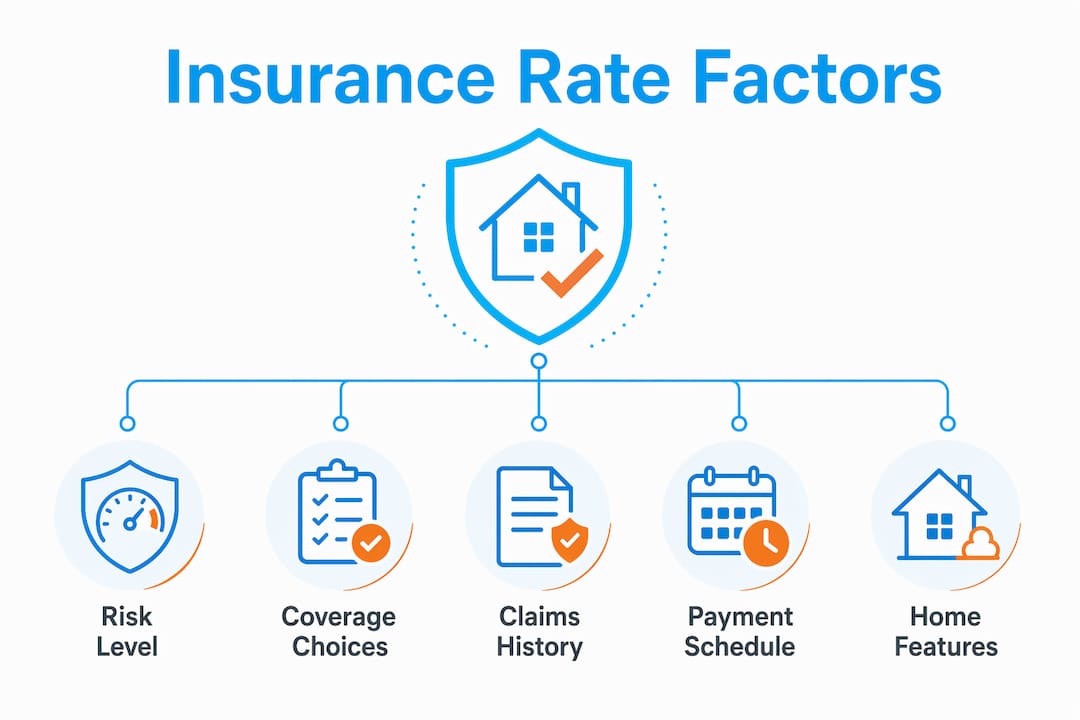
Finally, your payment schedule affects your total cost. Paying your full annual premium upfront or enrolling in autopay can reduce what you owe overall.
What is a home insurance quote vs. your actual premium?
A homeowners insurance quote is a preliminary price estimate based on the information you provide at the time of application. It is not a contract and it is not guaranteed. The final premium is what you actually owe after the insurer completes underwriting.
| Stage | What happens | Document to review |
|---|---|---|
| Quote | Insurer estimates cost using self-reported data | Quote summary sheet |
| Underwriting | Insurer verifies roof age, claims history, credit | Underwriting report |
| Policy issued | Final premium confirmed | Declarations page |
| Renewal | Premium adjusted based on updated risk data | Renewal notice |
The declarations page is the authoritative document. It lists your coverage amounts, deductibles, and final premium. Many homeowners treat the quote as the final number and are caught off guard when the declarations page shows a different figure.
Common reasons your premium shifts between quote and final policy include a roof inspection revealing older shingles, a claims history report showing prior losses, or a credit check returning a different score than expected. Asking your insurer which factors could change your premium before you commit is the single best way to avoid this surprise. Always read the declarations page before your first payment clears.
How can you reduce your home insurance premium?
Lowering your premium does not require sacrificing coverage. It requires making deliberate choices about risk, maintenance, and shopping habits.
- Choose the right deductible. A $1,000 deductible costs less annually than a $500 deductible. Make sure you have that amount in savings before raising it.
- Maintain your home. Insurers reward well-maintained properties. A new roof, updated wiring, and a working sump pump all reduce your risk profile.
- Bundle your policies. Combining home and auto coverage with one carrier typically earns a multi-policy discount. Mfandtna explains how bundling home and auto can produce meaningful savings without changing your coverage.
- Shop multiple quotes. Getting quotes from at least three insurers is the standard recommendation. Identical coverage can vary by hundreds of dollars annually across carriers.
- Pay annually or use autopay. Flexible payment options and discounts for paying upfront or enrolling in autopay reduce your total insurance cost over the year.
- Set your dwelling coverage at replacement cost, not market value. Replacement cost reflects what it actually costs to rebuild, including current labor and materials. Replacement cost coverage should include an inflation buffer to account for rising construction costs.
Pro Tip: Review your coverage limits every two to three years. Construction costs rise, and a dwelling limit that was accurate in 2022 may leave you underinsured today.
Key Takeaways
Your home insurance premium is determined by risk, coverage choices, and verified personal data. Knowing the difference between a quote and a final premium saves you from costly surprises at closing.
| Point | Details |
|---|---|
| Premium definition | The amount you pay to keep your homeowners policy active, billed monthly or annually. |
| National average cost | The average annual premium is approximately $2,424 for $300,000 in dwelling coverage. |
| Quote vs. premium | A quote is an estimate; the declarations page confirms your actual, final premium. |
| Top cost drivers | Location, roof condition, claims history, credit score, and coverage limits shape your rate. |
| Best savings moves | Raise your deductible, bundle policies, maintain your home, and compare at least three quotes. |
What 30 years of home insurance work has taught me
Most homeowners focus on the premium number and ignore the declarations page. That is the wrong priority. The declarations page is the only document that tells you what you actually owe and what you are actually covered for. I have seen homeowners pay a quote-based amount for months before realizing their final premium was higher because of a roof inspection they forgot about.
Escrow accounts add another layer of confusion. If your mortgage lender collects your insurance premium through escrow alongside your property taxes, a premium increase does not arrive as a separate bill. It shows up as a higher monthly mortgage payment, often with little explanation. Homeowners who do not track their escrow statements miss this entirely until their payment jumps by $80 or $100 a month.
The most effective thing you can do to control your premium over time is proactive risk mitigation. Replace your roof before it fails. Install a monitored security system. Fix that slow drain before it becomes a water damage claim. Insurers price risk. Reduce the risk, and the premium follows. I also recommend checking your dwelling coverage limit every two to three years against current local construction costs. A home insured for $280,000 in 2021 may cost $360,000 to rebuild today. That gap is your problem, not the insurer’s.
— Mike
Get a homeowners insurance quote tailored to your home
Understanding your premium is the first step. Getting the right coverage at the right price is the next one.
Mfandtna has spent over 30 years helping homeowners across multiple states find coverage that fits their home, their risk profile, and their budget. As an independent agency based in Arlington, MA, Mfandtna works with multiple carriers to compare options on your behalf. You are not locked into one company’s rates. Visit the homeowners insurance page to learn about coverage options, or go straight to free Massachusetts insurance quotes to see what your premium could look like with the right carrier.
FAQ
What is a home insurance premium in simple terms?
A home insurance premium is the payment you make to keep your homeowners insurance policy active. You pay it monthly, quarterly, or annually depending on your policy terms.
What is the average home insurance premium in the U.S.?
The national average annual premium is approximately $2,424 for $300,000 in dwelling coverage as of late 2025. Costs vary significantly by state, location, and coverage level.
Why did my home insurance premium increase at renewal?
Premiums rise at renewal due to updated risk data, including roof age, regional claim trends, inflation in construction costs, or changes to your credit-based insurance score. Reviewing your declarations page at each renewal shows exactly what changed.
How does a deductible affect my home insurance premium?
A higher deductible lowers your annual premium because you absorb more of the cost before insurance pays. Typical deductibles range from $500 to $2,000, so choose an amount you can comfortably cover out of pocket.
What is the difference between a home insurance quote and a premium?
A quote is a preliminary estimate based on self-reported information. Your actual premium is confirmed on the declarations page after the insurer completes underwriting and verifies your property details, claims history, and credit information.